
June 27, 2026
Retirement Income Has Cliffs. Here Is How to Find Yours.
Most retirement tax costs scale gradually. You earn more, you pay more. That part is predictable. But several of the most expensive income traps in retirement do not work that way. They are sudden. One dollar over a specific threshold and your annual healthcare cost jumps by thousands. One Roth conversion too large and a Medicare surcharge appears on your bill two years later. These are income cliffs, and most retirees never see them until they have already stepped off one.
There are four that affect most retirees before and after 65. Knowing where each one sits, in exact dollar terms, changes how you plan withdrawals, Roth conversions, and which accounts you draw from in any given year.
The ACA Subsidy Cliff at 400% FPL
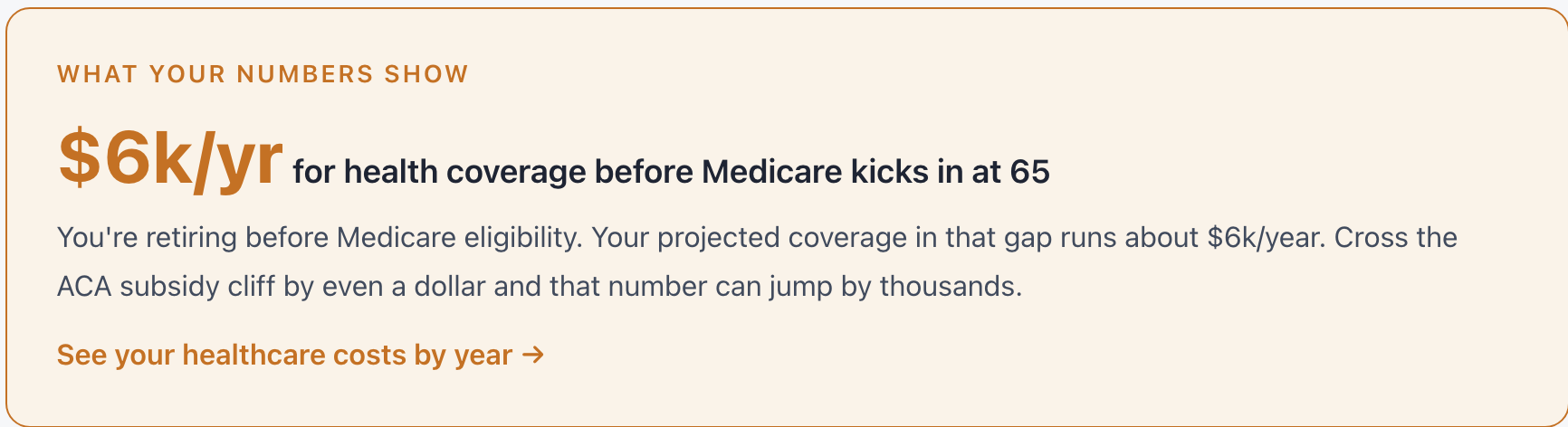
If you retire before 65, you buy health insurance on the ACA marketplace until Medicare starts. The monthly cost depends heavily on your MAGI relative to the federal poverty level for your household size.
Below 400% of the federal poverty level, you qualify for premium tax credits that cover most or all of your monthly premium. For a couple in 2026, that threshold falls around $81,760. For a single retiree, it sits around $60,240.
Above that line, the credits vanish. Not gradually. All at once.
A single retiree in their late fifties paying $45 per month under full subsidy can end up paying $1,000 per month the moment they cross that line. That is an $11,400 per year swing, triggered by a single dollar of additional income.
There is also a second ACA cliff that rarely gets mentioned. At 250% of the federal poverty level (roughly $39,900 for a single retiree, $54,100 for a couple), the Silver plan deductible jumps from around $700 to $5,500 and the out-of-pocket maximum rises from roughly $3,000 to $10,600. The monthly premium does not change. The exposure if you actually need medical care nearly triples.
Case Study: Sandra’s Roth Conversion Looked Smart Until the Health Insurance Bill Arrived
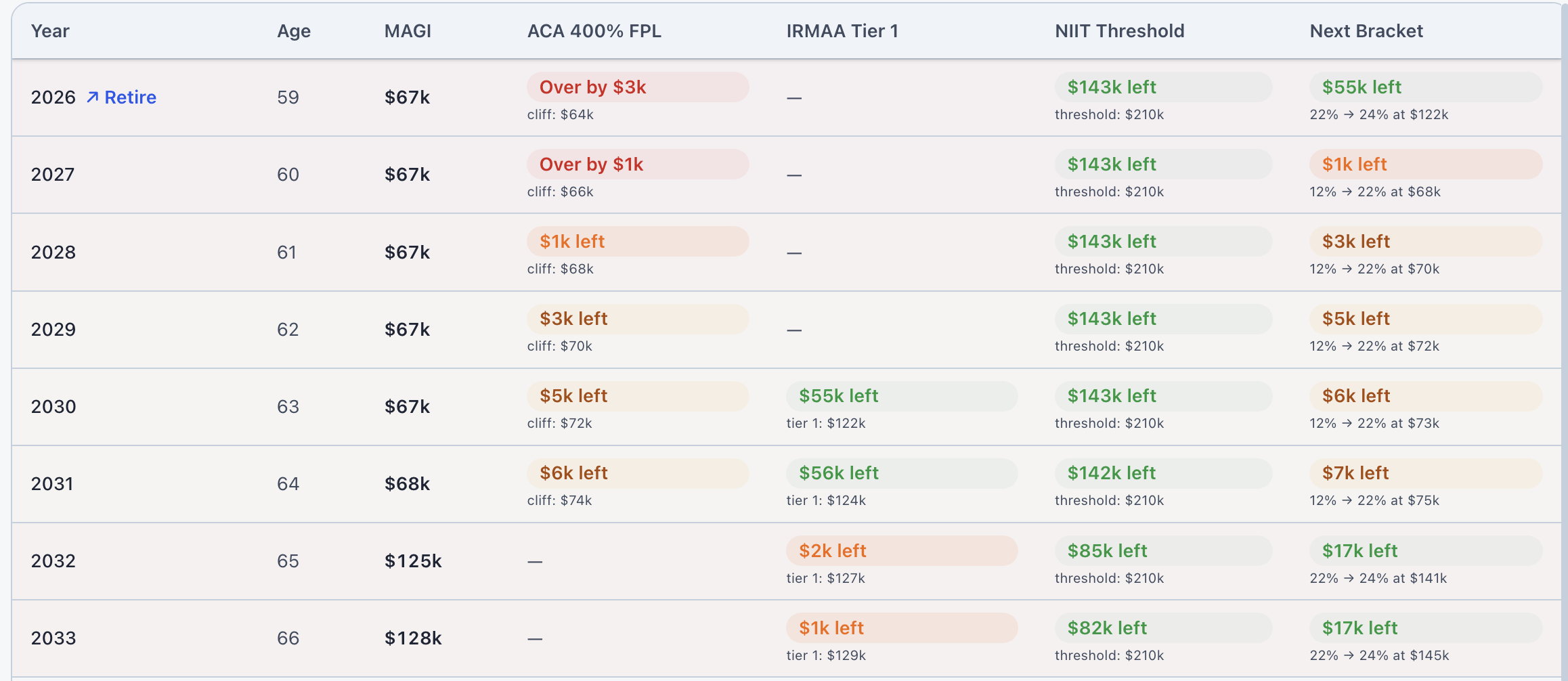
Sandra is 59 and recently retired. She draws about $22,000 per year from her brokerage account, mostly dividends. Her MAGI stays under $25,000. At that income, the ACA premium tax credit nearly eliminates her Silver plan premium. She pays $45 a month for solid coverage.
Her financial advisor recommends converting $45,000 from her traditional IRA to a Roth account. The timing looks reasonable. She is in the lowest tax bracket of her life. Her federal tax bill on the conversion comes to about $7,500. She has many years before RMDs would force withdrawals at higher rates. The advisor calls it a clear win.
What the advisor did not model was the ACA impact.
Converting $45,000 moves her MAGI from $22,000 to $67,000. That is $6,760 over the 400% FPL ceiling. Her subsidy disappears. The same Silver plan now costs $940 per month. That is $11,280 per year instead of $540.
The conversion cost $7,500 in federal taxes. It also cost $10,740 more in health insurance premiums than she would have paid without any conversion. She has six more years until Medicare. That is over $64,000 in extra healthcare costs from a single decision that looked obviously correct on paper.
A smaller conversion of $15,000 would have kept her MAGI well under the cliff, preserved six years of subsidies, and still grown her Roth balance gradually. The tax cost would have been less than $1,700.
IRMAA — The Medicare Cliff That Arrives Two Years Late
Once you turn 65 and switch to Medicare, the ACA subsidy cliff no longer applies. But a different set of thresholds takes over.
Medicare sets a base Part B premium around $185 per month. When your income crosses certain thresholds, Medicare adds surcharges on top of that. These are called IRMAA surcharges, and they apply to both Part B and Part D premiums.
What makes IRMAA particularly dangerous is the timing. Medicare uses your income from two years ago to set your current surcharges. Your 2026 income determines your 2028 Medicare premiums. A Roth conversion you do today will not show up on your Medicare bill for two years. By the time the cost arrives, most people have stopped connecting it to the decision that triggered it.
For a single filer in 2028, the first IRMAA tier begins around $112,000 and adds roughly $1,050 per year in surcharges. The second tier runs to about $177,000 and adds about $2,640 per year. The third tier climbs to around $212,000 and adds $4,230 per year. For a married couple, those surcharges double since they apply per Medicare enrollee.
IRMAA surcharges are smaller in absolute dollars than an ACA cliff loss. But they are real, they stack year after year, and they arrive as a surprise when you have already filed the return that caused them.
Case Study: Robert Sees the Roth Conversion Cost That Lands in 2028
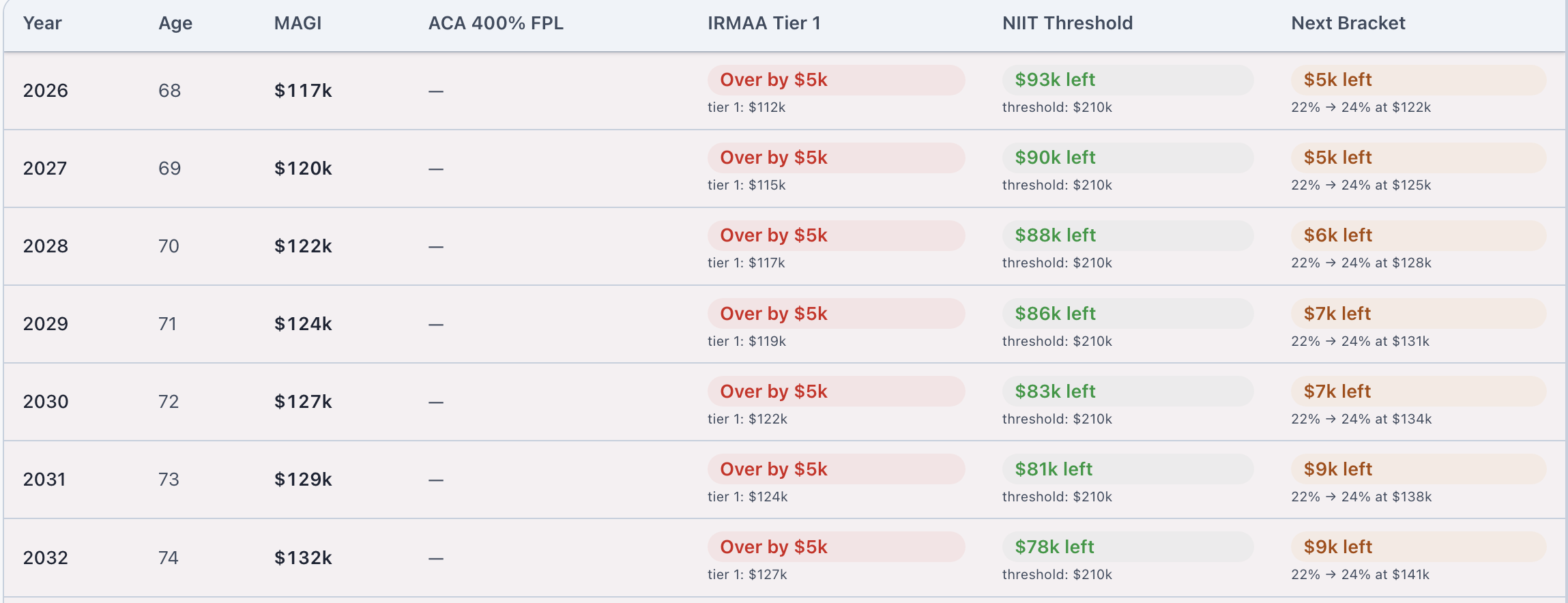
Robert is 68. He retired at 66 with a comfortable pension and a large traditional IRA that has kept growing. His current income from Social Security and pension runs about $95,000 per year. That sits below the first IRMAA threshold, so his Medicare premiums are at the standard rate.
He is planning a $67,000 Roth conversion this year. The math on the conversion itself is reasonable. He is 68, three years before his first required minimum distribution kicks in at 75, and moving money to Roth now reduces the forced withdrawals that will otherwise start at higher income levels.
But when he enters his projected $162,000 MAGI into the cliff indicator, the IRMAA section tells a fuller story. At $162,000, he is already in IRMAA tier 2, paying around $2,640 per year in Medicare surcharges. He is about $15,000 away from the tier 3 boundary at $177,000, where surcharges jump to roughly $4,230 per year.
He is not in danger of crossing tier 3. But he sees the full cost of the conversion. The federal tax on the $67,000 at his bracket runs about $16,000. The IRMAA tier 2 surcharge for 2028 adds another $2,640 on top of that, triggered by this year’s income two years from now. He decides the conversion still makes sense, but he now has the complete picture rather than just the tax bill.

Tax Bracket Headroom and the Net Investment Income Tax
Two more cliffs affect retirees at different income levels, though they behave more like ramps than walls.
The 22% federal tax bracket has a ceiling. For married filers in 2026, ordinary income above roughly $201,000 MAGI is taxed at 24%. This is the boundary most retirement planners use as the ceiling for Roth conversions. Knowing your exact dollar headroom to that line lets you fill the bracket without going over, which is the difference between paying 22 cents and 24 cents on every additional dollar of conversion.
The net investment income tax, or NIIT, adds a 3.8% surtax on dividends, capital gains, and interest once MAGI crosses $250,000 for married filers or $200,000 for single filers. It does not apply to IRA withdrawals or Roth conversions directly. But if a large taxable brokerage account pushes your investment income over the line, the surtax applies to the exposed portion. For someone realizing a large capital gain in retirement, this can add thousands of dollars that a simple tax bracket calculator misses.
Case Study: Tom and Linda Stay on the Right Side
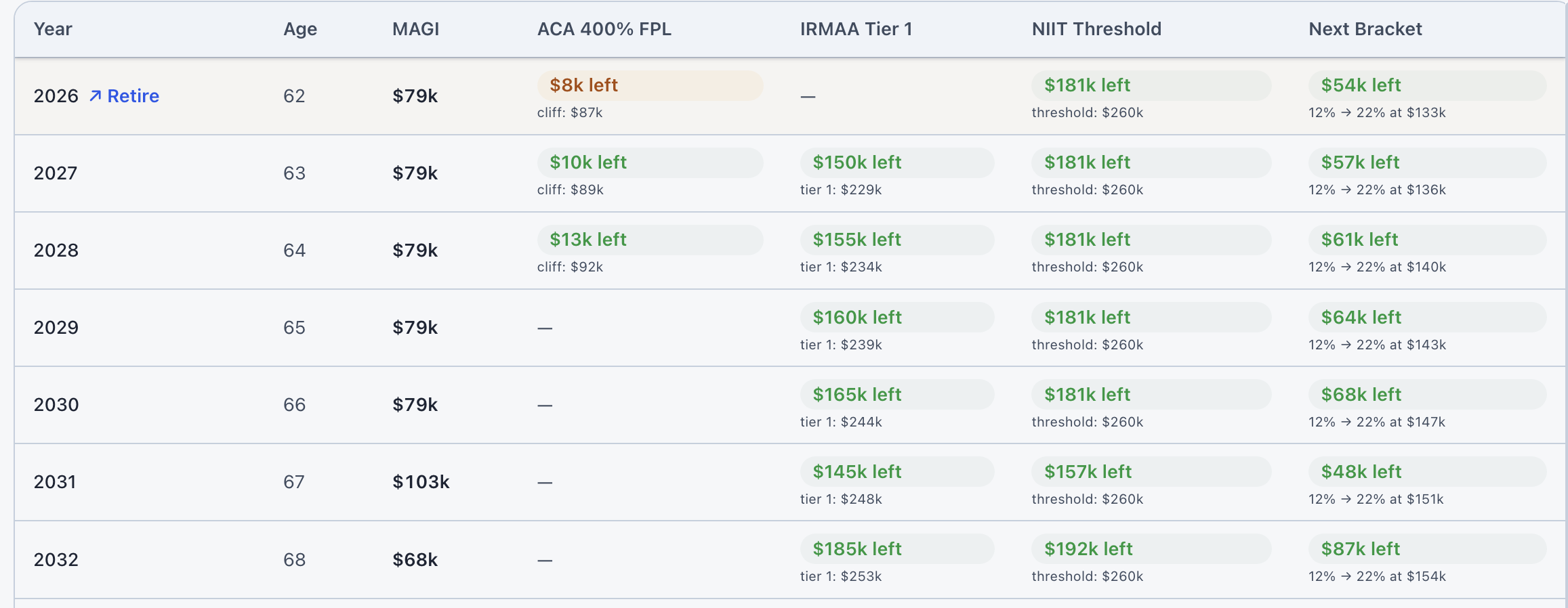
Tom and Linda are both 62 and recently retired. They live off their brokerage account and small Roth withdrawals while deferring Social Security until 67. Their base MAGI runs about $47,000 per year. As a household of two, the 400% FPL ceiling sits around $81,760. They have over $34,000 of headroom. The ACA section shows green.
They are planning a $32,000 Roth conversion. That would push their MAGI to $79,000. Still under the cliff, but just barely. At $79,000, the headroom to the ACA cliff drops to $2,760. The indicator turns orange. They are 3.4% from the boundary.
That margin is thin. A small capital gain distribution, a dividend they did not expect, or a one-time expense paid from the wrong account could push them over. They would lose the subsidy for the entire year, not just for the weeks they were over the line.
They trim the conversion to $22,000 instead. Their MAGI rises to $69,000, leaving $12,760 of headroom and returning the indicator to green. They still move money into Roth. They still reduce future RMD exposure. But they have a buffer that handles the unpredictable pieces without losing their subsidy.

Why Most Retirees Do Not See These Coming
The problem is not that these thresholds are secret. They are all in the tax code. The problem is that most financial software shows you one thing at a time.
A tax calculator shows your bracket. An ACA calculator shows your subsidy. A Medicare guide explains IRMAA in the abstract. None of them show all four thresholds side by side against your actual income, in dollar headroom, so you can see which cliffs are close and which are far.
The three people in these case studies all knew roughly what each rule said. None of them had modeled the combined effect of their income decisions against all the thresholds at once. Sandra did not see the ACA cliff because her advisor only ran the tax math. Tom and Linda did not see how thin their margin was until they looked at the dollar headroom rather than just the percentage. Robert did not connect a 2026 conversion to a 2028 Medicare bill until he saw the IRMAA section of the indicator.
Knowing your headroom in dollars, not just in concepts, is the difference between managing these thresholds and getting blindsided by them.
Check Your Own Cliffs Before the Next Conversion
The ThunderHarbor cliff indicator shows all four thresholds side by side with your exact dollar headroom to each one. You enter your MAGI, age, filing status, and household size. It shows which cliffs are safe, which are close, and which you have already crossed. It takes two minutes, and the result changes how you think about Roth conversions, capital gain timing, and Social Security decisions.
If you are planning any income-altering decision this year, checking your cliff headroom first is one of the fastest ways to catch a five-figure mistake before it happens.
For a deeper look at how ACA subsidies interact with Roth conversions in the years before Medicare, the post on Roth conversion strategy for early retirees walks through the full trade off. For the IRMAA side of the equation after 65, the piece on the 401k RMD bomb covers how large IRA balances turn into compounding IRMAA exposure over time.
Not financial advice
This article is for informational purposes only. Nothing here constitutes financial, tax, or legal advice. ACA subsidy rules, IRMAA thresholds, and tax brackets change year to year. Always consult a qualified professional before making significant financial decisions.
Find your cliff headroom in two minutes
The ThunderHarbor cliff indicator shows your exact dollar distance from the ACA cliff, IRMAA tiers, and tax bracket ceiling — all at once, with your real numbers.
Check my cliffs