
July 1, 2026
Old 401ks Are Quietly Setting Up Your Biggest Tax Bill
You changed jobs a few times over your career. Every job left behind a 401k. Maybe you rolled one into an IRA at some point. Maybe you never got around to it. Each account is small enough on its own that it never feels urgent to deal with.
The IRS does not care how many statements you get. It only cares about the total. Once you turn 75, all of that money starts coming out whether you want it or not. Four real situations below show where this actually bites, and what changes when you deal with it.
The RMD Problem at Scale
Karen and Bill are 54. Between them they have two old 401ks and a traditional IRA left over from jobs they left years ago, worth $1,245,000 combined. They plan to retire at 62. Neither of them has touched these accounts since leaving those jobs. The money just sits there, growing.
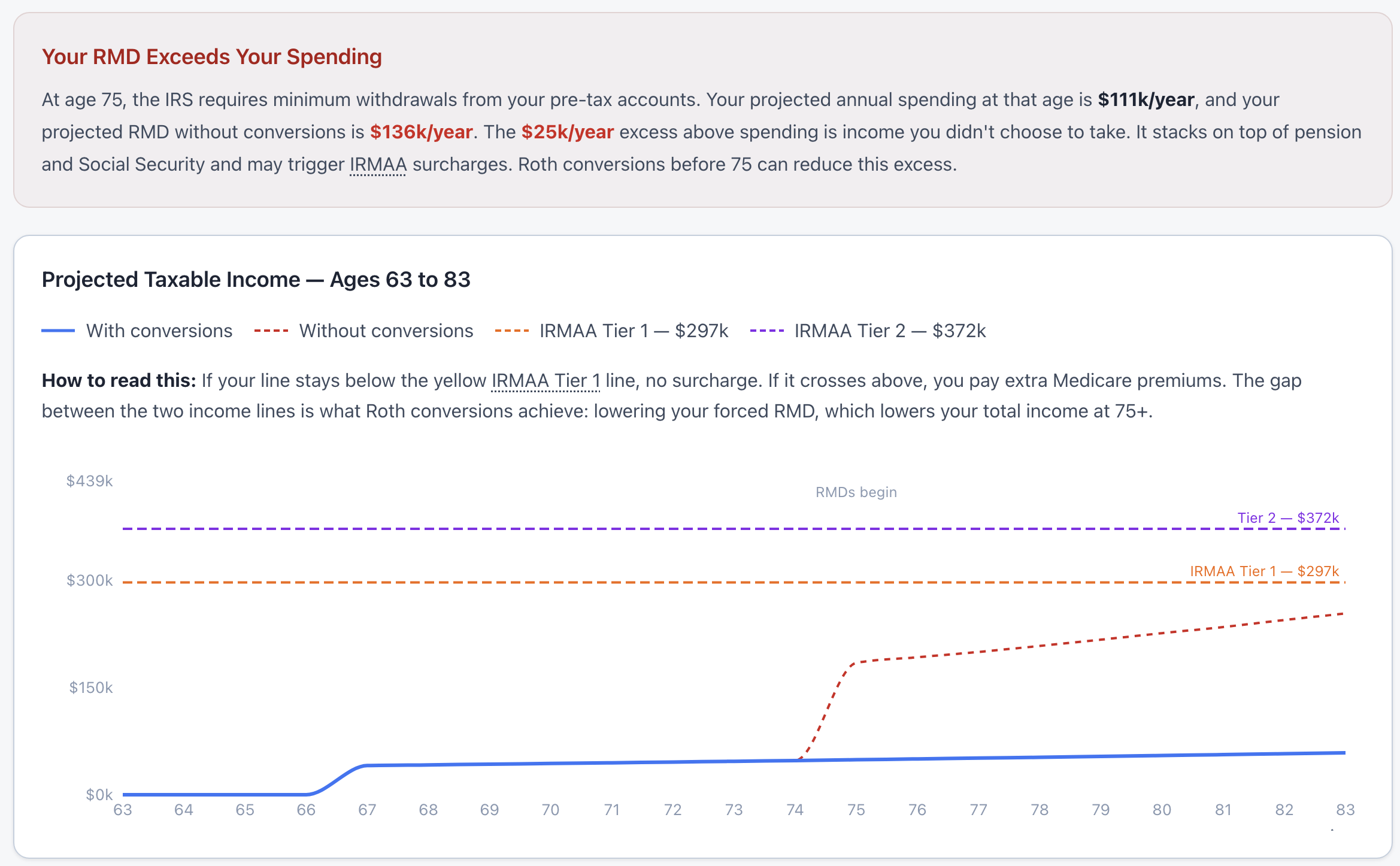
Run the numbers forward with no Roth conversion plan in place, and the picture changes at 75. That is when the IRS forces required minimum distributions from every one of those accounts. Combined, Karen and Bill's forced withdrawal comes to roughly $136,000 that year.
Their actual spending need at that age, adjusted for inflation, is about $111,000. The RMD exceeds it by almost $25,000. That excess is not money they asked for. It lands on top of the $58,000 they are already collecting from Social Security, pushing their household toward a higher bracket and within reach of a Medicare surcharge.
This is not a spending problem. It is a withdrawal problem, created by never having a conversion plan for money that has been quietly compounding since their thirties.
Retiring Early: The Rule of 55 vs. SEPP
Denise retired at 57. All of her retirement savings, $600,000, sits in a single traditional IRA. She needs to draw from it now, more than two years before she turns 59½.
Normally that means a 10% early withdrawal penalty on top of ordinary income tax. The Rule of 55 is the exception most people have heard of. It lets you tap a 401k penalty free if you leave your job in the year you turn 55 or later. The catch is that the Rule of 55 only applies to 401k plans. Denise's money is in an IRA, so the rule does not help her at all.
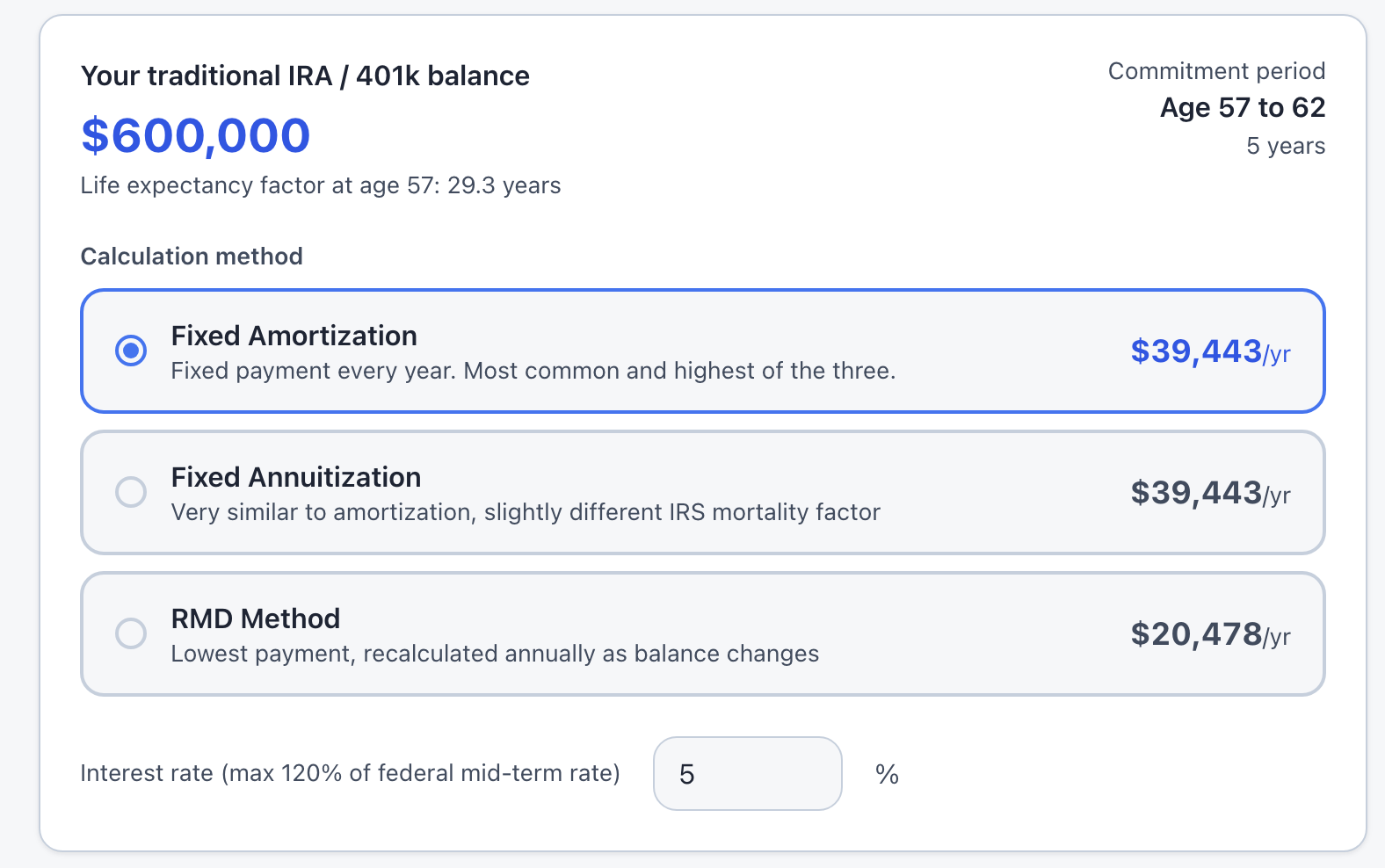
Her real option is a 72(t) SEPP plan. It lets her take substantially equal periodic payments from the IRA without the penalty, as long as she commits to the schedule for five years or until 59½, whichever is longer. On her balance, the fixed amortization method works out to about $39,443 a year. The lower RMD method would only allow about $20,478.
The commitment is the real cost. Once she starts, she cannot adjust the amount or stop early without triggering the penalty retroactively on everything she already withdrew. If that same $600,000 had been left in a 401k instead of rolled into an IRA, the Rule of 55 would have given her the same penalty free access with none of the five year lock in.
Backdoor Roth Headroom: Why Where the Money Sits Matters
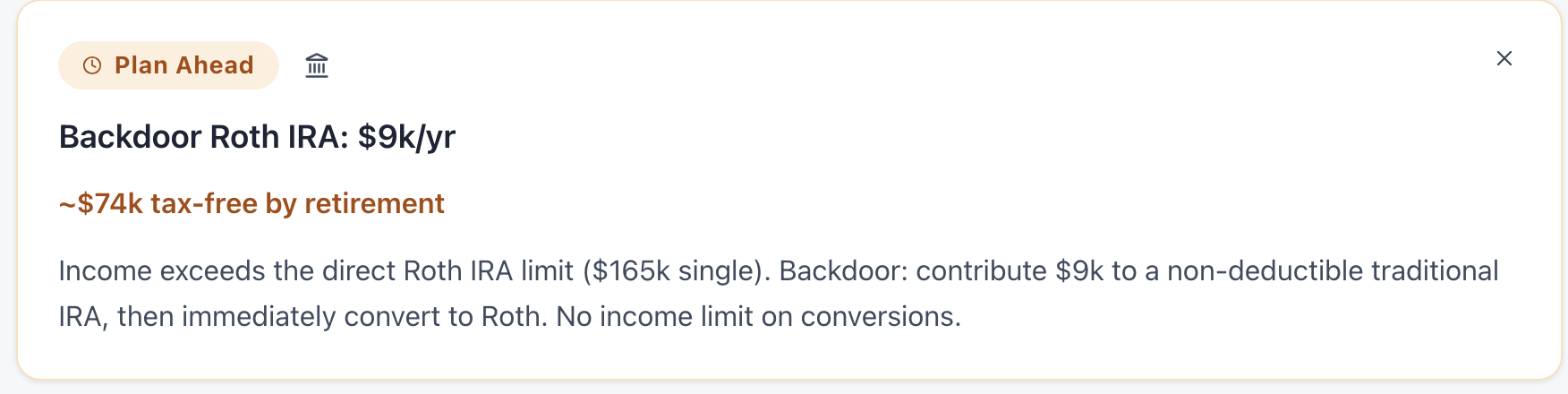
Walter is 58 and single. His income is well above the $165,000 limit for contributing to a Roth IRA directly. He also has $400,000 sitting in an old rollover account from a previous job.
The standard workaround for high earners is the backdoor Roth. Contribute new money to a traditional IRA as an after tax contribution, then immediately convert it to Roth. Done cleanly, the conversion is close to tax free.
The IRS will not let Walter cherry pick which dollars he converts. A rule called pro-rata treats every traditional IRA a person owns as one pool when converting. If Walter's $400,000 sits in a traditional IRA, his new backdoor contribution gets diluted into that pool. Almost all of the conversion comes out taxable, and the strategy stops working.
Move that same $400,000 into a 401k instead of an IRA, and the pro-rata rule no longer applies. Only IRA balances count toward it. With the 401k holding the old money, Walter's new $9,000 backdoor contribution converts cleanly, growing to roughly $74,000 tax free by retirement.
NUA: The One Old 401k You Might Not Want to Roll Over
One old 401k deserves a different conversation before you roll it anywhere. If it holds employer stock that has grown a lot in value, rolling the whole thing into an IRA like everything else can be a mistake.
Net unrealized appreciation, or NUA, is a special rule for employer stock held inside a 401k. Instead of rolling it over, you can distribute the stock directly to a taxable account. You pay ordinary income tax on the original cost basis right away. Everything the stock has appreciated since then gets taxed later at long term capital gains rates when you sell, instead of ordinary income rates the way a normal IRA withdrawal would be taxed.
ThunderHarbor does not have a dedicated NUA calculator yet. If this applies to you, model the taxable gain portion yourself. Go to Future Income, add a one time event, and set the type to Capital Gains. That gives you a rough comparison against a straight rollover.
The Simplification Win: One Unified RMD
Karen and Bill's scattered accounts do not have to stay scattered. Roll the old 401ks and the IRA into one traditional IRA and the total does not change. It is still $1.2 million. What changes is how much there is to track.
Instead of three separate statements and three separate RMD calculations, there is one account and one number. ThunderHarbor's Full Report lays it out as a single, coherent story instead of three scattered ones.
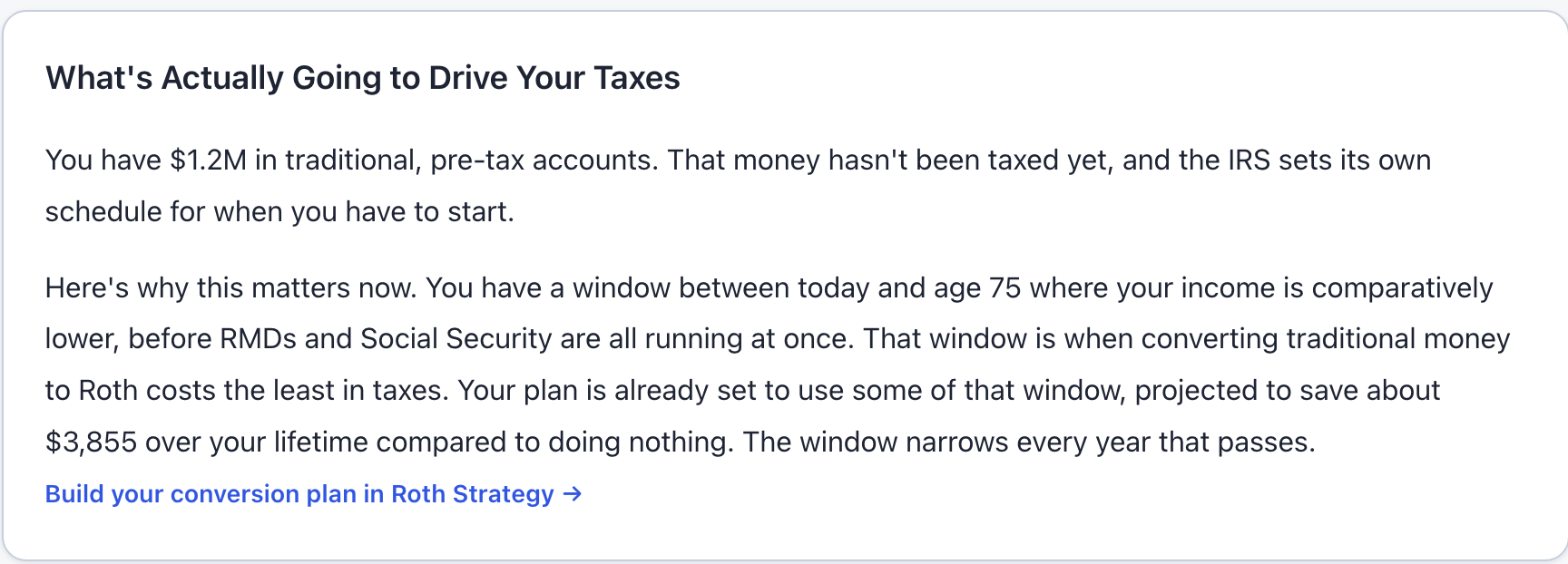
Consolidating does not by itself fix the excess RMD problem from the first case study. That still takes an actual Roth conversion plan in the years before 75. But it clears away the administrative noise that makes it easy to never start one. With their current plan already converting some of that window, Karen and Bill are projected to save about $3,855 over their lifetime compared to doing nothing. It is a start, not a finish.
Why Most People Never Deal With This
None of the four people in these case studies did anything wrong. They changed jobs, they kept working, they saved consistently. Nobody ever sat down and added the accounts up as one household, one forced withdrawal number, one strategy.
Old 401ks and IRAs from past jobs are the most common blind spot in retirement planning. Each one looks too small to matter on its own. Add them together and run them forward to 75, and the picture usually looks very different.
Not financial advice
This article is for informational purposes only. Nothing here constitutes financial, tax, or legal advice. RMD ages, 72(t) SEPP rules, and IRS pro-rata treatment change year to year. Always consult a qualified professional before making significant financial decisions.
See what your own scattered accounts add up to
ThunderHarbor projects your RMDs, SEPP options, and Roth conversion room using your real account balances, as one plan instead of a stack of old statements.
Build my plan