
July 21, 2026
Your Retirement Number Is Not the Finish Line
Most people treat their retirement number like a finish line. Hit it, and the race is over. In practice it works more like a starting gun. The habits that got you to your number, growing a portfolio while you kept adding to it, are not the habits that protect it once you start taking money out instead.
Three real-shaped scenarios below walk through the whole arc: finding the number itself, what happens to a plan that does not shift once you reach it, and why the account you withdraw from matters almost as much as the amount.
Your number is a subtraction problem, not a round figure
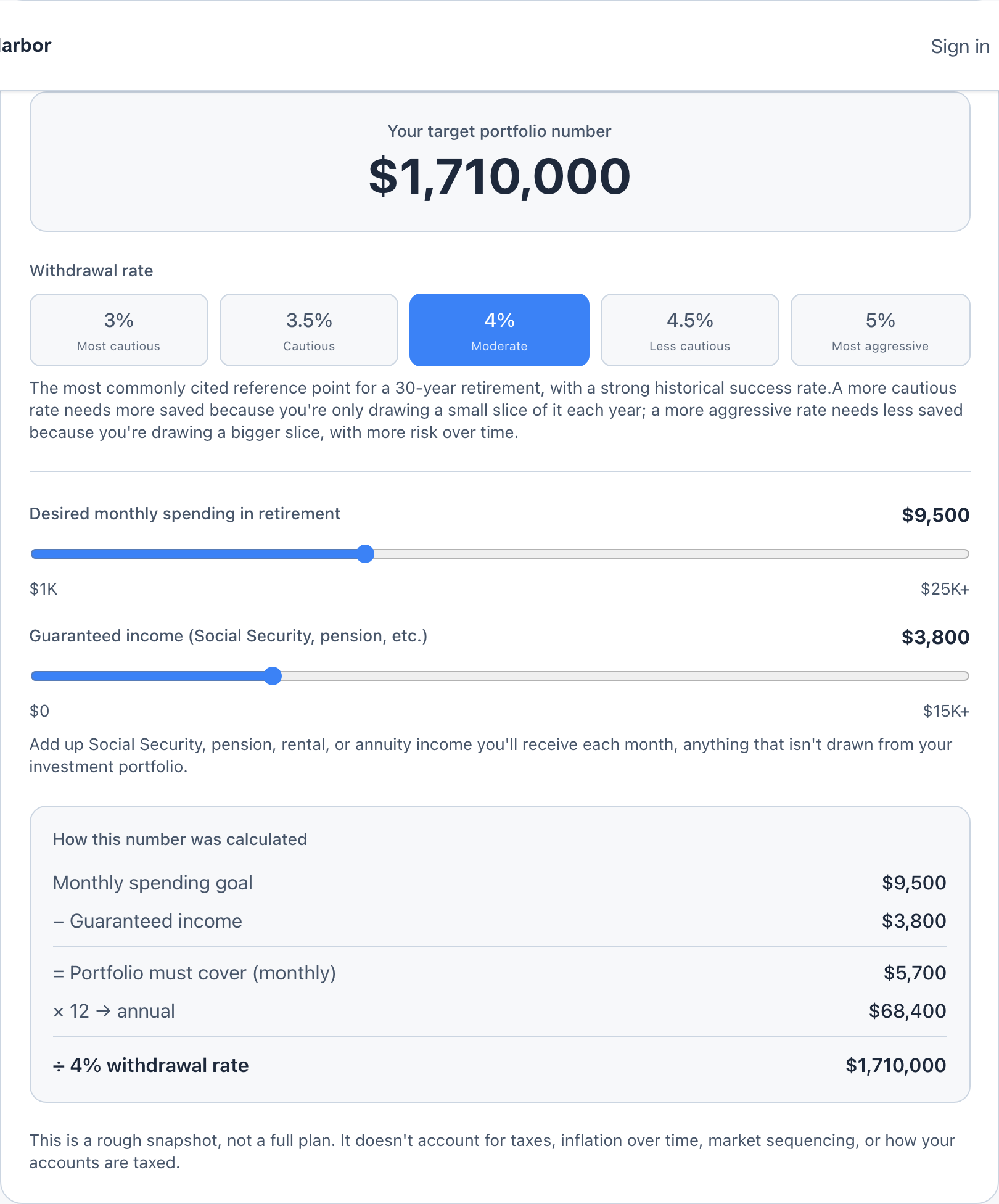
Ignore the round numbers people throw around online, a million here, five million there. None of them mean anything without your own inputs. Your actual number comes from three things: what you plan to spend, what guaranteed income already covers part of it (Social Security, a pension, rental income), and the withdrawal rate you are comfortable drawing from what is left.
Subtract guaranteed income from spending to find the monthly gap your portfolio has to cover. Annualize it, then divide by your withdrawal rate. A more cautious rate needs a bigger portfolio because you are only drawing a small slice of it each year. A more aggressive rate needs less saved, but a bigger slice comes with more risk of running out over a long retirement.
Case Study: Diane and Frank Find a Number That Actually Fits Them
Diane and Frank want $9,500 a month in retirement, enough to travel twice a year and keep their current lifestyle. Between them, Social Security will pay $3,800 a month once both claim. That leaves a gap of $5,700 a month, or $68,400 a year, that their portfolio needs to cover.
At a 4% withdrawal rate, $68,400 divided by 0.04 comes out to $1.71 million. Frank had been fixated on a $2.5 million target he saw mentioned in a forum thread, a number with no relationship to his actual spending or his actual Social Security benefit. Once they ran their own numbers, they realized they were closer than they thought, and that the extra saving they had planned for the next three years was solving a problem they did not have.
Diane wanted to see the number at a more cautious withdrawal rate too. At 3.5%, the same $68,400 gap works out to $1.95 million, a quarter million more just from choosing a more conservative rate. Seeing both numbers side by side, not just one, is what let them decide how much cushion actually mattered to them.
Reaching your number changes the assignment
While you are saving, a bad year in the market barely matters. You keep contributing, you buy more shares at lower prices, and the average return over a couple of decades is what determines your outcome, not any single year. The moment you start withdrawing instead of contributing, that stops being true.
A downturn early in retirement does two things at once: your portfolio drops, and you are pulling money out of it at the same time, selling shares at depressed prices to cover spending. That combination can permanently damage a portfolio even when the market fully recovers a few years later, a dynamic usually called sequence-of-returns risk. The average bear market recovers within about two and a half years. In worse cases, it has stretched closer to five.
Case Study: Walter Keeps the Portfolio That Got Him Here
Walter retired at 64 with a portfolio built almost entirely from a handful of growth stocks that had carried him through three decades of accumulation. The positions had earned him real loyalty. He kept the same allocation into retirement, reasoning that what had worked for thirty years would keep working.
Eighteen months into retirement, the market dropped 28%, concentrated hardest in the exact sector Walter was overweight in. He still needed his monthly withdrawal, so he sold shares at the bottom to cover it, month after month, for the better part of a year. By the time the market recovered, his portfolio had far fewer shares left to participate in the recovery. The withdrawals he made during the decline were permanent in a way the decline itself was not.
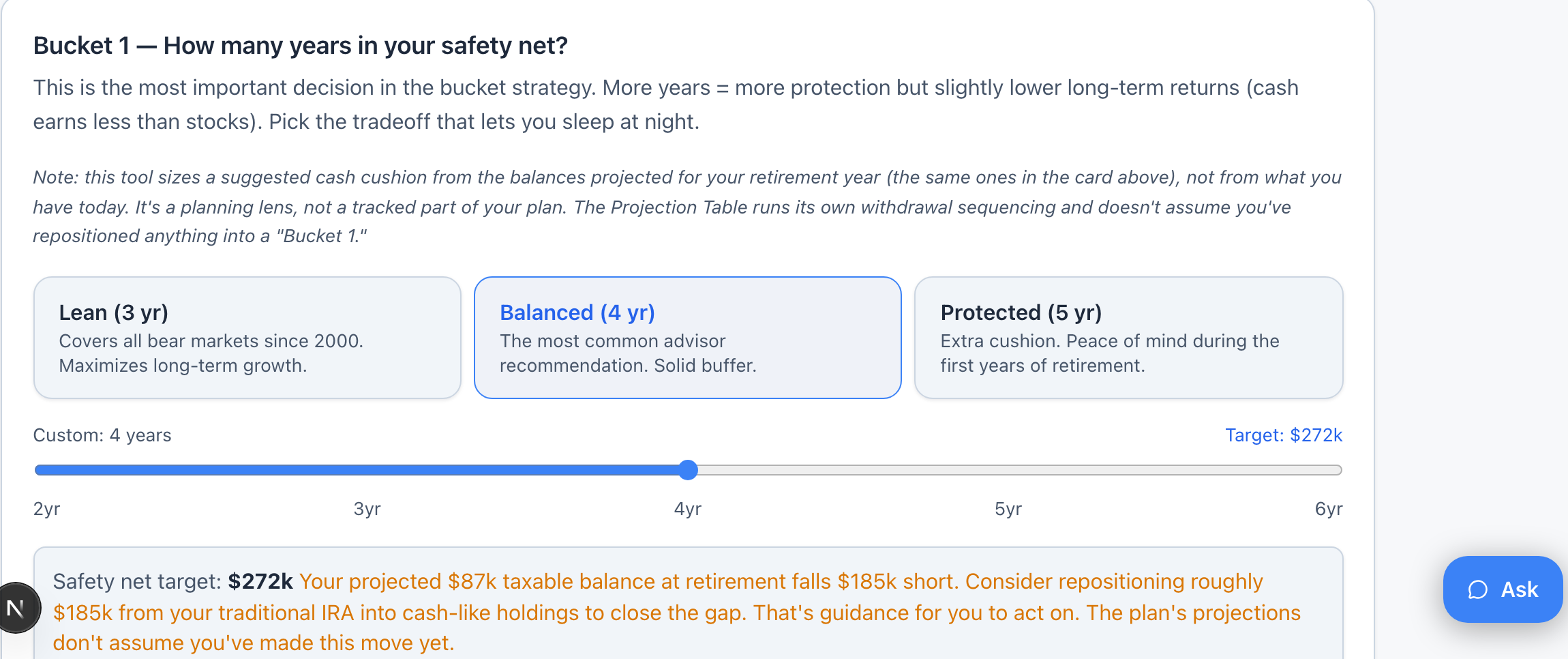
The fix is not a generic 60/40 split adopted because it is what retirees are supposed to do. It is sizing a specific cash and short-term bond reserve, based on your own withdrawal gap, so a downturn never forces a sale. ThunderHarbor's Bucket Strategy sizes that first bucket directly from your spending minus your guaranteed income, then checks it against how long past bear markets have actually taken to recover.
Where the money comes from matters almost as much as how much
A dollar is not a dollar once taxes get involved. A dollar withdrawn from a Roth account arrives tax-free. The same dollar from a traditional IRA is taxed as ordinary income. The same dollar realized as a long-term capital gain from a taxable brokerage account is often taxed at a lower rate than either. Most retirees hold some mix of all three, and the order they draw from determines how much of their own money they actually keep.
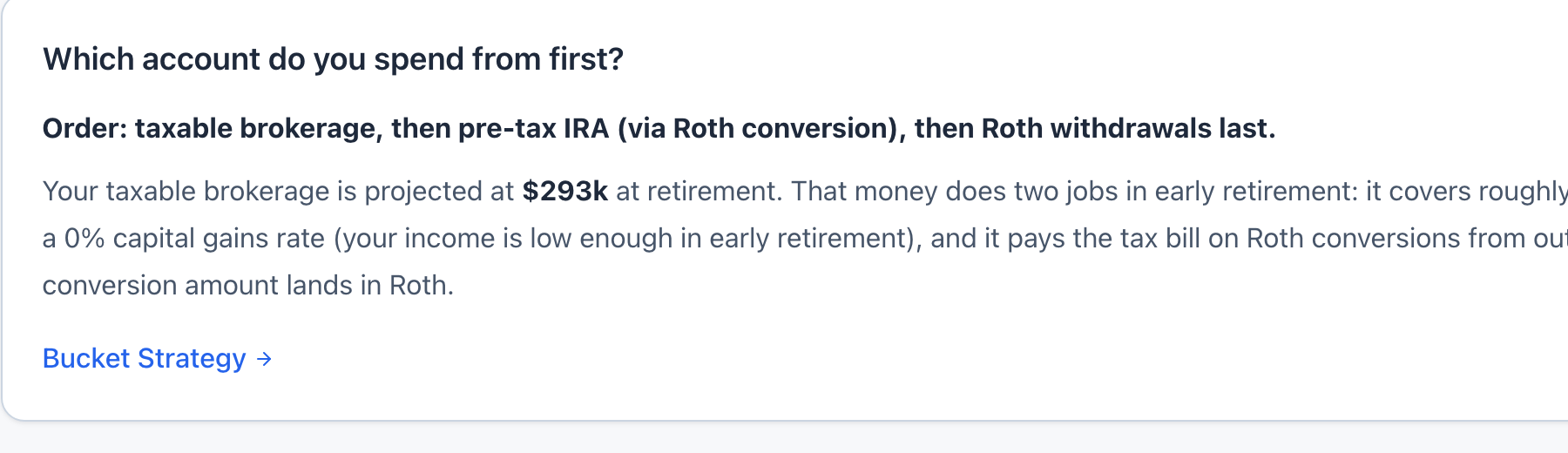
The general shape that tends to minimize lifetime taxes: spend from the taxable brokerage account first, since long-term capital gains rates are often at or below ordinary income rates. Draw from traditional accounts up to a threshold that keeps you under a bracket, IRMAA tier, or ACA subsidy cliff. Use Roth withdrawals to fill any remaining gap without pushing income higher. Only lean harder on traditional accounts once the more efficient sources are exhausted.
Case Study: Priya Draws From the Same Accounts in a Different Order
Priya retired at 61 with $650,000 in a traditional IRA, $340,000 in a taxable brokerage account, and $210,000 in a Roth IRA. She needs about $5,200 a month until Medicare and Social Security both start at 65 and 67. Her first instinct, shared by a lot of retirees, was to leave the Roth alone since it is the account she is most protective of, and draw from the traditional IRA to cover the gap.
Drawing $5,200 a month from the traditional IRA pushes her MAGI high enough to lose most of her ACA subsidy and land her in a higher bracket than necessary, years before any of it was required. Spending from the taxable brokerage account first instead keeps her MAGI low enough to hold onto the subsidy, taxes the growth at capital gains rates rather than ordinary rates, and leaves both the traditional IRA and the Roth to keep compounding untouched through her early sixties.
Knowing the number is half the plan
Diane and Frank, Walter, and Priya all needed the same first step: a real number based on their own spending and their own guaranteed income, not a figure borrowed from someone else's situation. The ThunderHarbor Retirement Number Calculator gets you that number in under a minute.
But the number by itself would not have protected Walter from a bad first year of withdrawals, and it would not have shown Priya which account to draw from first. That is the other half, sizing a reserve against a downturn and sequencing withdrawals to minimize taxes, and it is why a single snapshot number is a starting point rather than a finished plan. For more on the downturn side specifically, the guide on sequence-of-returns risk walks through the mechanics in more detail.
Not financial advice
This article is for informational purposes only. Nothing here constitutes financial, tax, or legal advice. Withdrawal rates, tax brackets, and account rules change over time and depend on your individual situation. Always consult a qualified professional before making significant financial decisions.
Find your number, then protect it
The Retirement Number Calculator shows your target portfolio in under a minute. ThunderHarbor's full plan sizes the cash reserve and withdrawal order that keep it safe once you get there.
Find my number