
July 21, 2026
How to Model an Inheritance You Have Not Received Yet
A specific, expected inheritance is real information about your future portfolio. Leaving it out understates what you will actually have. Forcing all of it into one income entry overstates your future tax bill. Neither is right, since a mix of inherited accounts is not one asset, it is several, each taxed differently.
The Problem With Treating It All as One Number
Most retirement tools give you one way to enter a future windfall, a single dollar amount landing in a single year, usually treated as taxable income. That works fine for something like a home sale. It works badly for an inheritance, since what you actually inherit is rarely just one thing.
A parent's estate might include a traditional IRA, taxed as ordinary income when withdrawn and subject to the SECURE Act's 10-year distribution window for most beneficiaries. It might include a Roth IRA, generally tax-free on withdrawal. And it might include a taxable brokerage account or cash, which usually receives a step-up in cost basis and is not itself a taxable event to receive at all. Entering the combined total as ordinary income overstates the tax bill on two of those three pieces, and understates your actual future portfolio value, since the tool assumes a big chunk of it disappears to taxes that were never actually owed.
Case Study: Jordan, Expecting a Mixed Inheritance in Three Years
Jordan is 58, single, lives in North Carolina, and plans to retire in two years. A parent's estate plan makes clear that Jordan will inherit two things in about three years, a traditional IRA worth roughly $90,000 and a brokerage account worth roughly $200,000. Jordan wants both reflected in the plan without guessing at a single blended number.
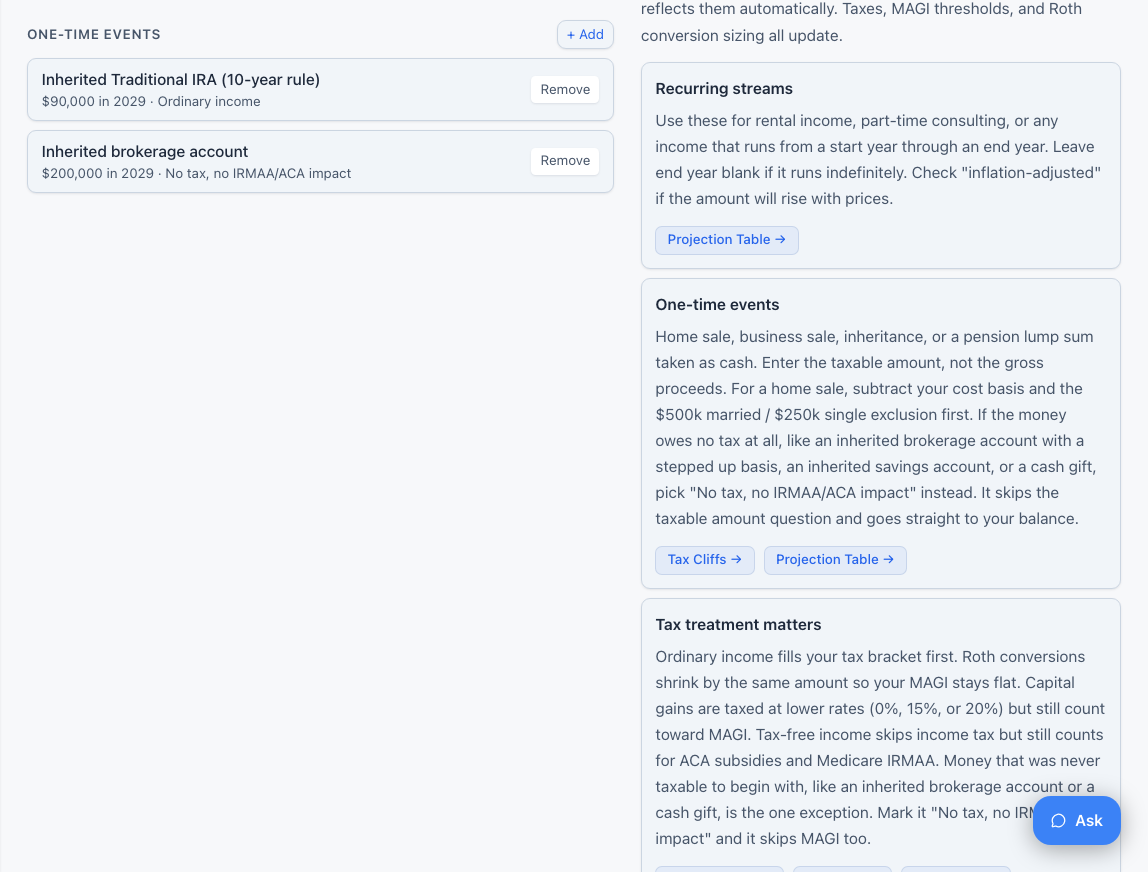
The $90,000 traditional IRA is entered as ordinary income, which flows into Jordan's tax bracket, MAGI, and any ACA or IRMAA thresholds the same way a large withdrawal would. The $200,000 brokerage account is entered as a separate event, using the option built for money that lands in a taxable account with no tax owed at receipt. It adds directly to Jordan's projected portfolio balance and grows from there, with no effect on tax bracket, MAGI, ACA subsidy, or IRMAA in the year it arrives.
That distinction changes two different numbers in Jordan's plan. The tax and MAGI impact three years from now reflects only the $90,000 that actually generates one, not $290,000. And the long-run portfolio balance reflects the full $200,000 brokerage inheritance actually compounding, instead of either being left out of the plan entirely or shrunk by taxes that were never owed on it.
Where the Line Actually Sits
Not every future dollar belongs in a retirement projection this way. The reason this one does is that it changes real planning decisions, not just a running total. Knowing $200,000 is coming, tax-free at receipt, changes how much Jordan needs to save between now and retirement, how conservatively to invest in the meantime, and how much Roth conversion room to use in the years before the inheritance lands versus after. Knowing the $90,000 IRA distribution is coming changes what tax bracket and IRMAA tier those same years are likely to fall into. Those are retirement-strategy questions, not budgeting line items.
The same option works for more than inheritances. A cash gift, an insurance payout with no tax owed at receipt, or any other windfall that lands in a taxable account without triggering ordinary income belongs in the same category. What it is not for is everyday income. Anything that is really taxable, a pension, a distribution, a home sale with gain above the exclusion, still belongs in one of the other categories, where the tax and MAGI impact is real and needs to show up in the plan.
Not financial advice
This article is for informational purposes only. Nothing here constitutes financial, tax, or legal advice. Inherited account rules, the SECURE Act's distribution window, and cost basis step-up rules can change, and estate outcomes are never guaranteed. Always consult an estate attorney or tax professional for your specific situation.
Model each part of an expected inheritance the right way
ThunderHarbor lets you enter a future inheritance, gift, or windfall as the type of money it actually is, not one blended guess.
Start your free plan