
October 10, 2026
What Moves When You Change One Thing in Your Retirement Plan
Claim Social Security at 67 or 70? Retire at 62 or 64? Stay in California or move? Each of these is a comparison, and a comparison only means something if everything else stays the same. So we took one couple, froze their plan, and changed one thing at a time. Some changes moved their taxes. Some moved only the money they leave. Two of them overlapped and did not add up.
The couple and the baseline
Marcus is 58 and Elena is 56. They live in California and both still work, earning $190,000 and $125,000. They have $1.77 million in two traditional 401ks, a $140,000 Roth IRA, and a $310,000 brokerage account. Together they put $44,500 a year into the 401ks. They spend $125,000 a year in today's dollars. They plan to stop working at 62 and claim Social Security at 67. They use the app's default portfolio and its default Roth conversion setting.
On that plan their money lasts past 95. They pay $1,019,327 in federal and state tax across their retired years. Their first required distribution, at 75, is $49,216. At 90 they have $5.07 million. All dollars are future dollars, and “retirement taxes” counts only the years after they stop working.
That is the baseline. Every row below changes one thing and leaves the rest alone.
Six changes, one baseline
| What changes | Retirement taxes | Balance at 90 | RMD at 75 |
|---|---|---|---|
| Baseline (both retire at 62, claim at 67, stay in California) | $1,019,327 | $5.07M | $49,216 |
| Both claim Social Security at 70 | -$41,265 | $4.94M (-$126k) | $43,402 |
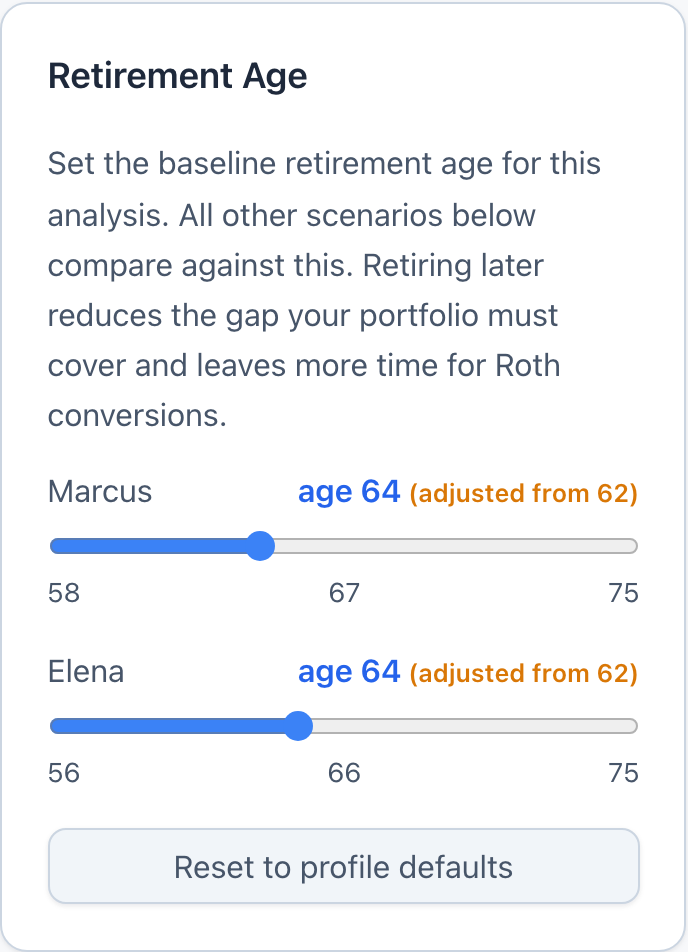
| Both retire two years later, at 64 | +$188,941 | $6.52M (+$1.46M) | $63,507 |
| Both work part-time until 68 ($60k and $40k) | +$348,124 | $6.87M (+$1.80M) | $72,218 |
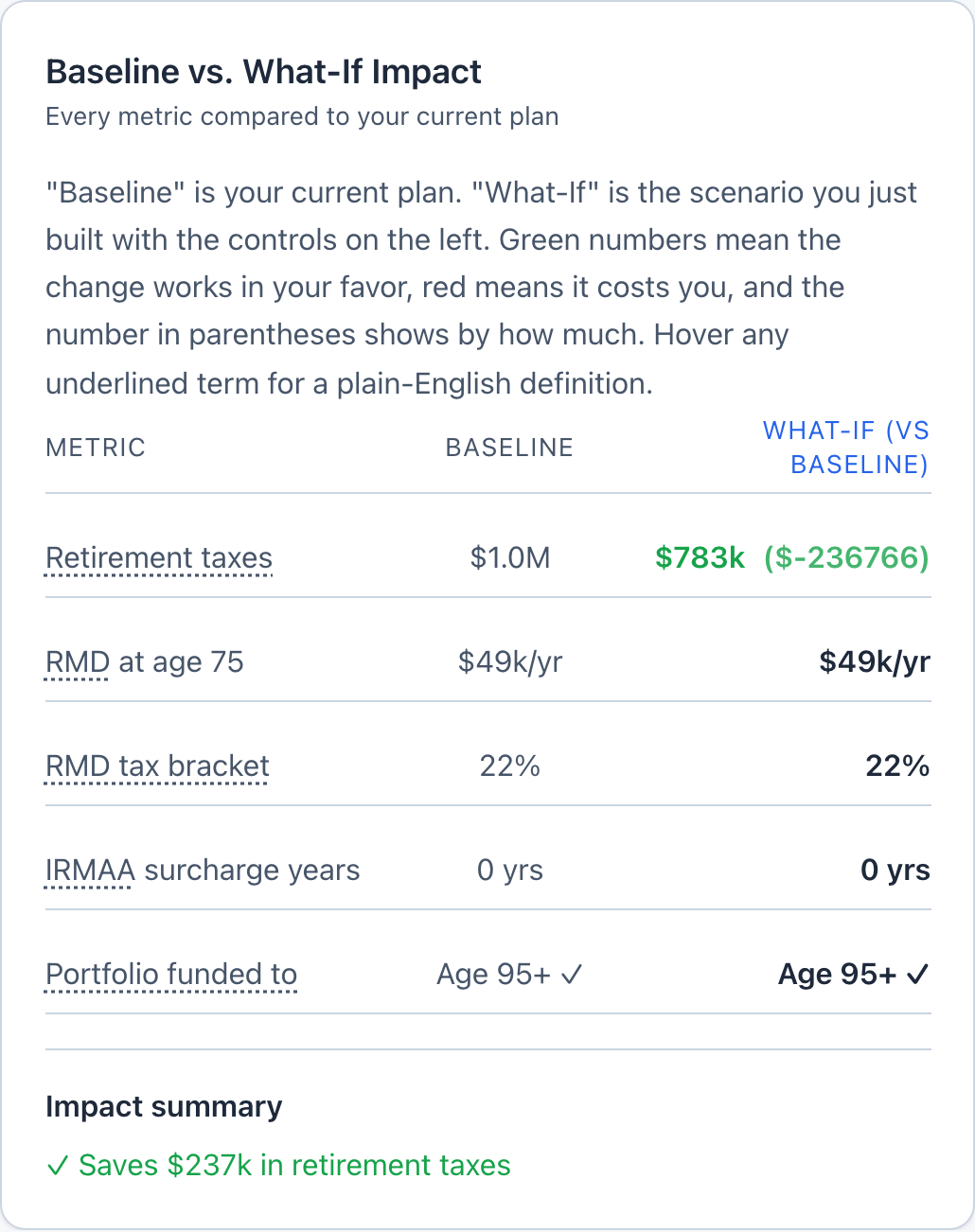
| Move to Nevada the year they retire | -$236,766 | $5.65M (+$580k) | $49,216 |
| Spend 10% less | no change | $6.20M (+$1.13M) | $49,216 |
| Long-term care from 83 ($90k a year, 4 years each) | -$8,636 | $2.90M (-$2.17M) | $49,216 |
Retirement taxes show the change from the baseline of $1,019,327. Balance at 90 is the total of all accounts in future dollars, with the change from $5.07 million in brackets. Care costs start at $90,000 a year per person in today's dollars and grow with inflation to the year they happen.
Read across a row and the measures often disagree. The next three sections take that apart.
A lower tax bill does not always leave you with more
Claiming Social Security at 70 instead of 67 lowers their retirement taxes by $41,265 and their first RMD by $5,814. On taxes alone, that is a clear win. It leaves them with less money for most of retirement, though. At 85 they have $4.36 million instead of $4.54 million, which is $177,000 less. By 95 the gap closes to $46,000. They pay less tax and wait eight years to collect more.
Retiring two years later goes the other way. Their retirement taxes rise by $188,941 and they pay one year of IRMAA surcharge. They also have $1.46 million more at 90. Two more years of salary and savings make the accounts bigger, and bigger accounts produce more taxable income later. The higher tax bill comes with the extra money.
Some changes do not touch the tax bill
Spending 10% less leaves their retirement taxes at $1,019,327, the same to the dollar in every retired year. It leaves them $1.13 million richer at 90.
Here is why. By default the plan converts as much traditional money to Roth each year as fits in a target bracket. When they spend less, they need $197,832 less from their traditional accounts over retirement. The plan converts exactly that much more. It fills the bracket either way, so the tax does not move, and the money they did not spend stays in Roth.
Long-term care works the same way. The tax bill moves by $8,636. The balance at 90 falls by $2.17 million, because the care comes out of money they would otherwise have kept. If you watched only taxes, you would think neither change matters. The balances say it does.
When you move matters as much as where
California taxes retirement income and Nevada has no income tax. Moving to Nevada the year they fully retire cuts their retirement taxes by $236,766 and leaves $580,000 more at 90.
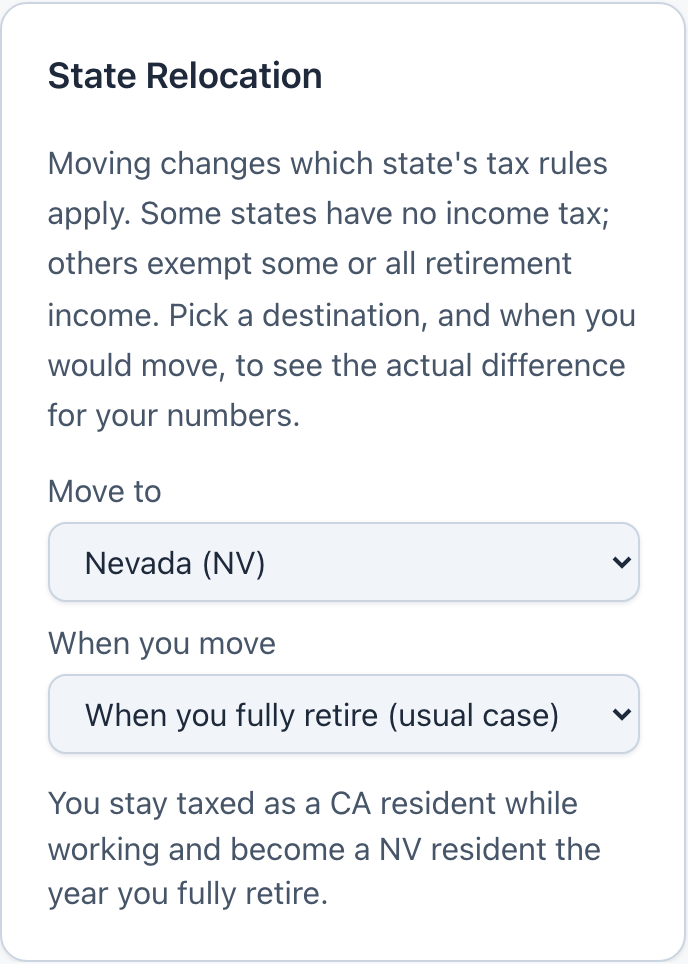
Moving right away cuts $268,446. That is $31,680 more. It comes from two years when Marcus has stopped working and Elena has not. The plan counts a household as fully retired when the later of the two stops. Moving right away would also save about $73,000 of California tax in the four years before Marcus retires, and the retirement-tax number does not include that. Most people cannot move on day one, so the tab lets you choose when. A model that applies the new state from the first year overstates the saving for anyone still working.

Two ways of working longer share the same years
Working two more years adds $1.46 million at 90. Working part-time until 68 adds $1.80 million. Add them together and you would expect $3.26 million. Run them together and the plan shows $2.59 million, which is $666,000 less.
They overlap. Part-time income starts when each of them stops full-time work and runs until 68. Retiring at 62 leaves six years of part-time pay. Retiring at 64 leaves four. The second change uses years the first one already used.
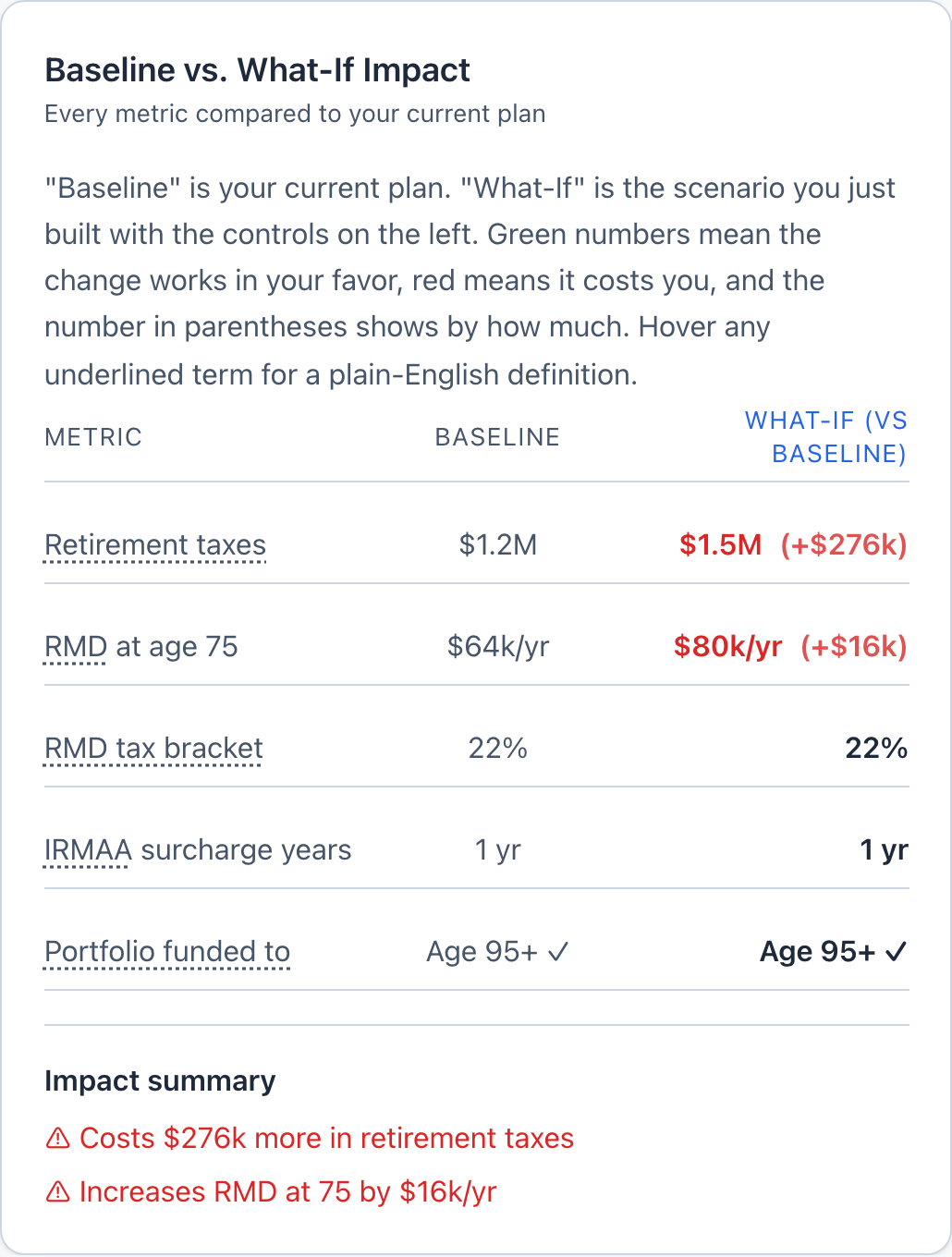
This is hard to see by hand. Each change looks sound alone. Together they are worth less than their sum. You see it when the same baseline sits under every comparison.
Why one fixed baseline matters
Everything above depends on the baseline staying put. Each row compares against the same $1,019,327 and the same $5.07 million. If the starting plan shifts a little between questions, the differences stop meaning anything. You could not tell whether a $41,265 gap came from claiming later or from a different starting point.
That is why we do not think a chat with an AI replaces this. A chat can explain what IRMAA is and reason well about one question. Comparing six changes against one frozen plan, with the interactions worked out the same way every time, is a different job. We wrote about where AI helps and where it drifts in What Spreadsheets, AI, and Retirement Calculators All Miss.
What the numbers leave out
None of this says what Marcus and Elena should do. Moving saves $237,000 and takes them away from friends. Retiring at 64 leaves more money and costs two years of the time they planned to spend differently. Claiming at 70 is a bet on living past 80. The tab shows what each choice does. It does not tell you what two more years are worth to you. We wrote about that in A Retirement Advisor Can Optimize Your Money. No One Can Optimize Your Life.
We ran one return path with the default portfolio and 3% inflation. Markets will not follow it. Treat the gaps between rows as the useful part and the totals as one plausible path.
Not financial advice
This article is for informational purposes only. Nothing here constitutes financial, tax, or legal advice. The household is hypothetical. Markets and tax law will differ from our assumptions, and your own situation changes every answer. Talk to a tax professional before you change your plan.
Run these same what-ifs on your own plan
The What-If Workshop in ThunderHarbor holds your plan fixed and shows each change against it. Nothing changes your real plan until you apply it.
Start your free plan