
July 9, 2026
SSDI and Early Medicare: How They Actually Fit Into Your Retirement Plan
If you are on Social Security Disability Insurance, or you qualify for Medicare before 65 through disability, ALS, or End-Stage Renal Disease, most retirement advice was not written with your timeline in mind. Below is how each one actually works, and two real plans built around them.
SSDI Is Not Regular Social Security
Regular Social Security gives you a choice. Claim at 62 and your monthly check is smaller for life. Wait until 70 and it is bigger for life. That choice, and the break-even math behind it, is the entire subject of most Social Security calculators.
SSDI does not work that way. There is no minimum age and no claiming-age choice. Your benefit amount is set by the SSA disability formula, and it starts as soon as your claim is approved, whether you are 35 or 55. Then, the month you reach Full Retirement Age, the SSA converts it into a regular retirement benefit automatically. No application. No gap in payments. Often a different dollar amount, on a date that was fixed the day you were born.
SSDI is taxed the same way a regular benefit is, under the partial-taxation formula that can make up to 85% of it taxable depending on your combined income. It also counts toward MAGI for ACA and IRMAA purposes, the same as a regular benefit. Entering it as a pension or as ordinary wages gets the tax treatment wrong.
A calculator with a single field for Social Security, asking you to pick a claiming age from 62 to 70, cannot represent any of this. Most people in this situation either leave the income out, guess a claiming age that does not match reality, or enter it as a pension. Each of those choices moves the tax bracket, the ACA subsidy, or both, in the wrong direction.
Case Study: Diane, 50, on SSDI Since Her Forties
Diane is 50, single, and lives in Florida. She has been on SSDI for several years, currently paying $24,000 a year. Her Social Security statement shows a Full Retirement Age benefit of $32,000 a year at 67. She has $400,000 in a traditional 401k and $100,000 in a taxable brokerage account, and expects to spend $55,000 a year.

Her plan needs to carry $24,000 a year in SSDI for the next 17 years, then switch to $32,000 a year the month she turns 67, with no decision attached to either number.

The detail worth planning around is the jump itself. Diane's guaranteed income rises by $8,000 a year on a date that has been fixed since she was approved for SSDI. That is a known, dated event, the same way turning 65 is a known, dated event for Medicare, and it changes what a Roth conversion should look like in the years right before it. A plan that cannot see the jump cannot help her time around it.
Medicare Before 65: Three Ways It Actually Happens
Anyone receiving SSDI is enrolled in Medicare automatically 24 months after their SSDI payments start, no application needed. Anyone diagnosed with ALS is enrolled the same month their SSDI starts, with no waiting period at all. Anyone with End-Stage Renal Disease generally qualifies within a few months of starting dialysis or receiving a transplant. All three can put someone on Medicare decades before 65.
A calculator built around a 65-year-old Medicare start date gets this wrong in two directions at once. It shows a healthcare coverage gap for years that are already covered, which overstates costs that do not apply. And it misses IRMAA surcharges that already apply today, because it assumes IRMAA cannot start before 65.
Case Study: Frank, 58, on Medicare Since 56
Frank is 58, single, and lives in Florida. He retired two years ago at 56 and qualified for Medicare that same year through SSDI. Medigap is not guaranteed-issue in every state before 65, so he has been on a Medicare Advantage plan instead. He has $2.2 million in a traditional 401k and $300,000 in a brokerage account, plans to spend $70,000 a year, and his statement shows a $28,000 Full Retirement Age benefit at 67.
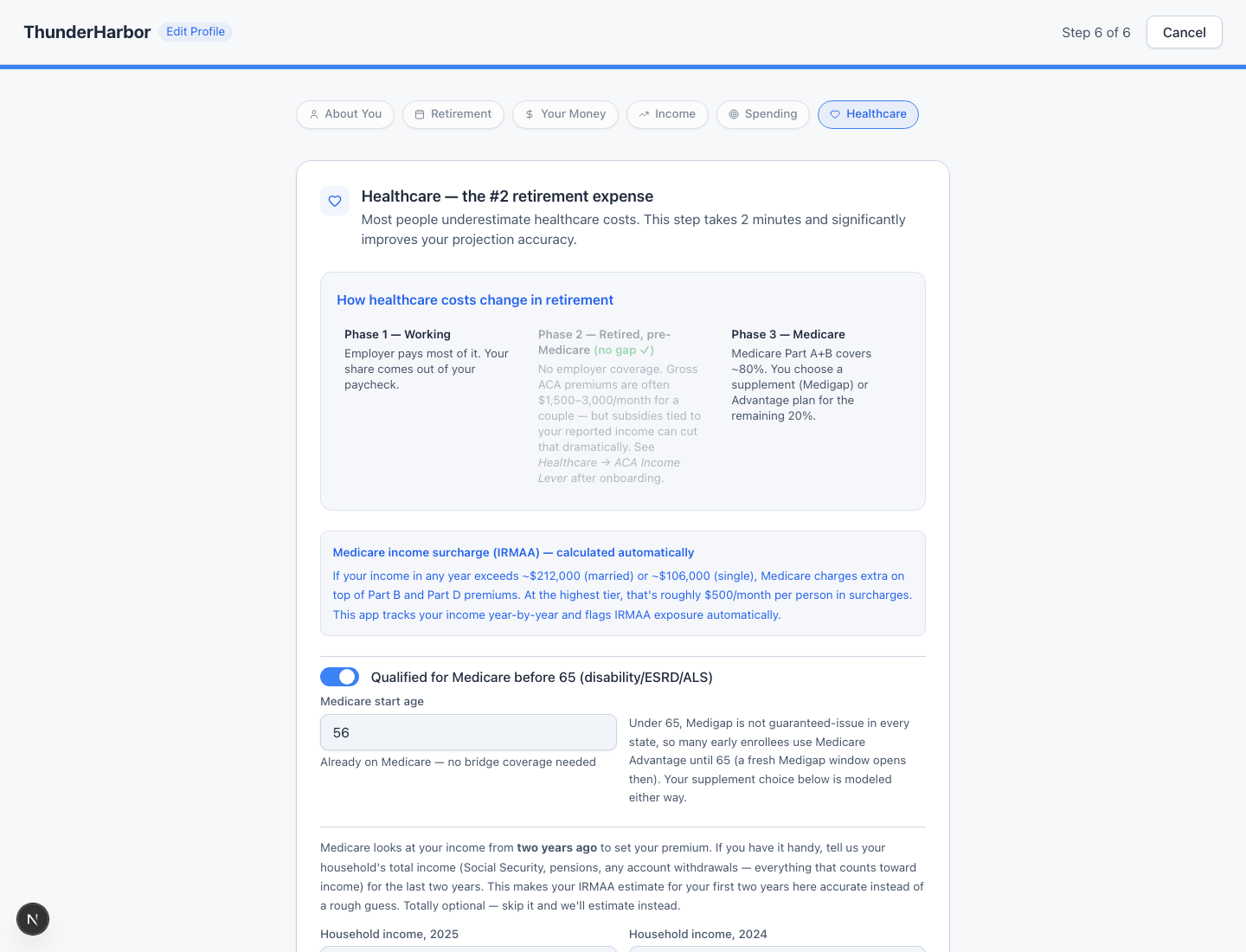
The number worth sitting with is when IRMAA actually catches up to Frank. In his plan, his income crosses the first IRMAA tier in 2031, the year he turns 63, two years before most tools would even start checking, since most tools hardcode 65 as the earliest possible IRMAA year.
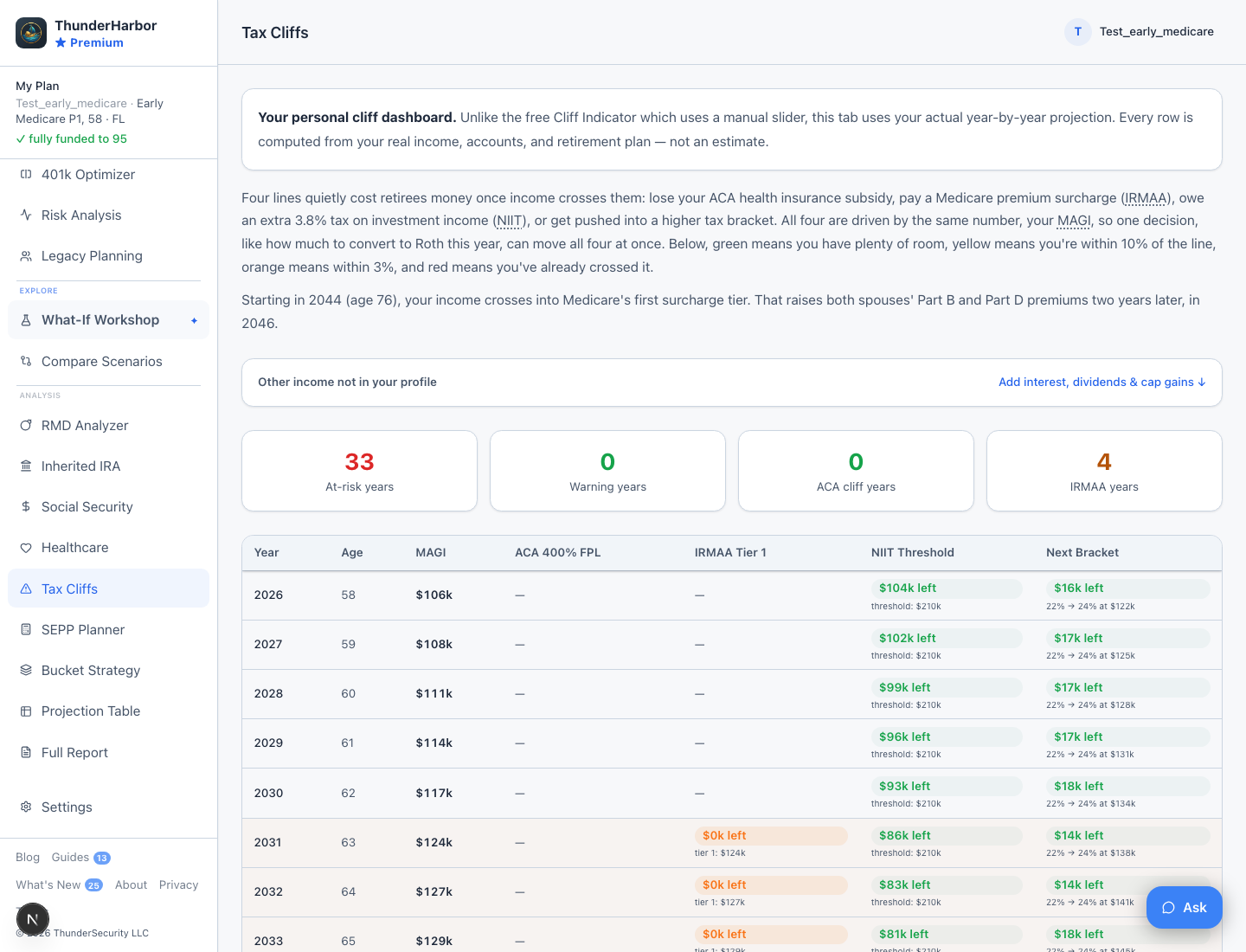
Over his projection, Frank's plan shows roughly $225,000 in lifetime Medicare premiums, $133,000 in lifetime out-of-pocket costs, and $36,000 in lifetime IRMAA surcharges. None of that is a coverage gap. It is Medicare cost that started years earlier than a standard timeline assumes, which means his room to convert traditional money to Roth without tripping an IRMAA tier is tighter today than a 58-year-old still years from Medicare would have.
The Honest Summary
Diane and Frank are hitting the same wall from two different directions. A rule most planning tools bake in as fixed, a Social Security claiming age, a Medicare start date at 65, has a real exception, and neither of their plans works if that exception gets ignored.
Not everyone reading this is on SSDI or qualifies for early Medicare through ESRD or ALS. But if you are, or you are helping a parent or a spouse figure out their numbers, you deserve a plan built on the timeline you actually have. ThunderHarbor now asks for your real SSDI amount and your real Medicare start age directly, and the projection, Roth Strategy, Tax Cliffs, Full Report, and in-app assistant all carry those real numbers through instead of assuming your timeline looks like everyone else's.
Not financial advice
This article is for informational purposes only. Nothing here constitutes financial, tax, or legal advice. SSDI, Medicare, and IRMAA rules change from year to year, and eligibility depends on your specific medical and work history. Always consult the Social Security Administration, Medicare.gov, or a qualified professional before making decisions based on your own situation.
See your real SSDI and Medicare timeline reflected in your plan
ThunderHarbor models your actual SSDI amount and Medicare start age, not a default timeline built for someone else's situation.
Start your free plan