
July 12, 2026
The Rule of 55 Only Covers One 401k. Here Is Which One.
Most people who have heard of the Rule of 55 know the headline. Leave your job at 55 or later, and you can tap that 401k penalty-free before 59½. Fewer people know how narrow the exception actually is, and how easy it is to lose by mistake.
One Plan, Not Your Whole Retirement Account
Withdraw from a 401k or an IRA before 59½ and the IRS normally adds a 10% penalty on top of ordinary income tax. The Rule of 55 is a specific, narrow exception to that penalty. IRC section 72(t)(2)(A)(v) waives it for withdrawals from a 401k or 403b, as long as you separate from that employer in or after the calendar year you turn 55.
The word doing the most work in that sentence is "that." The exception covers one plan, the 401k or 403b belonging to the employer you are leaving, in the year you leave it. It does not cover a 401k sitting at a job you left three years ago. It does not cover an IRA, even if every dollar in that IRA came from a 401k originally. And it disappears the moment you roll that specific 401k into an IRA, even if you roll it over the same day you separate.
None of this shows up if you enter your accounts as one lump traditional balance. The projection needs to know which dollars sit in the plan you are actually leaving, since that is the only place the exception applies.
Case Study: Carla, 56, Retiring From Her Current Job
Carla is 56, single, and lives in Texas. She has $900,000 in the 401k at the job she is retiring from this year, $150,000 in a traditional IRA that holds an old 401k from a job she left a decade ago, and $50,000 in a taxable brokerage account. She plans to spend $60,000 a year and will not claim Social Security until 67.
Carla qualifies for the Rule of 55 on the $900,000, since she is separating from that employer this year, at 56. She does not qualify on the $150,000 IRA. That old 401k stopped being Rule of 55 eligible the day it left her former employer's plan, years before this retirement was even on the calendar.
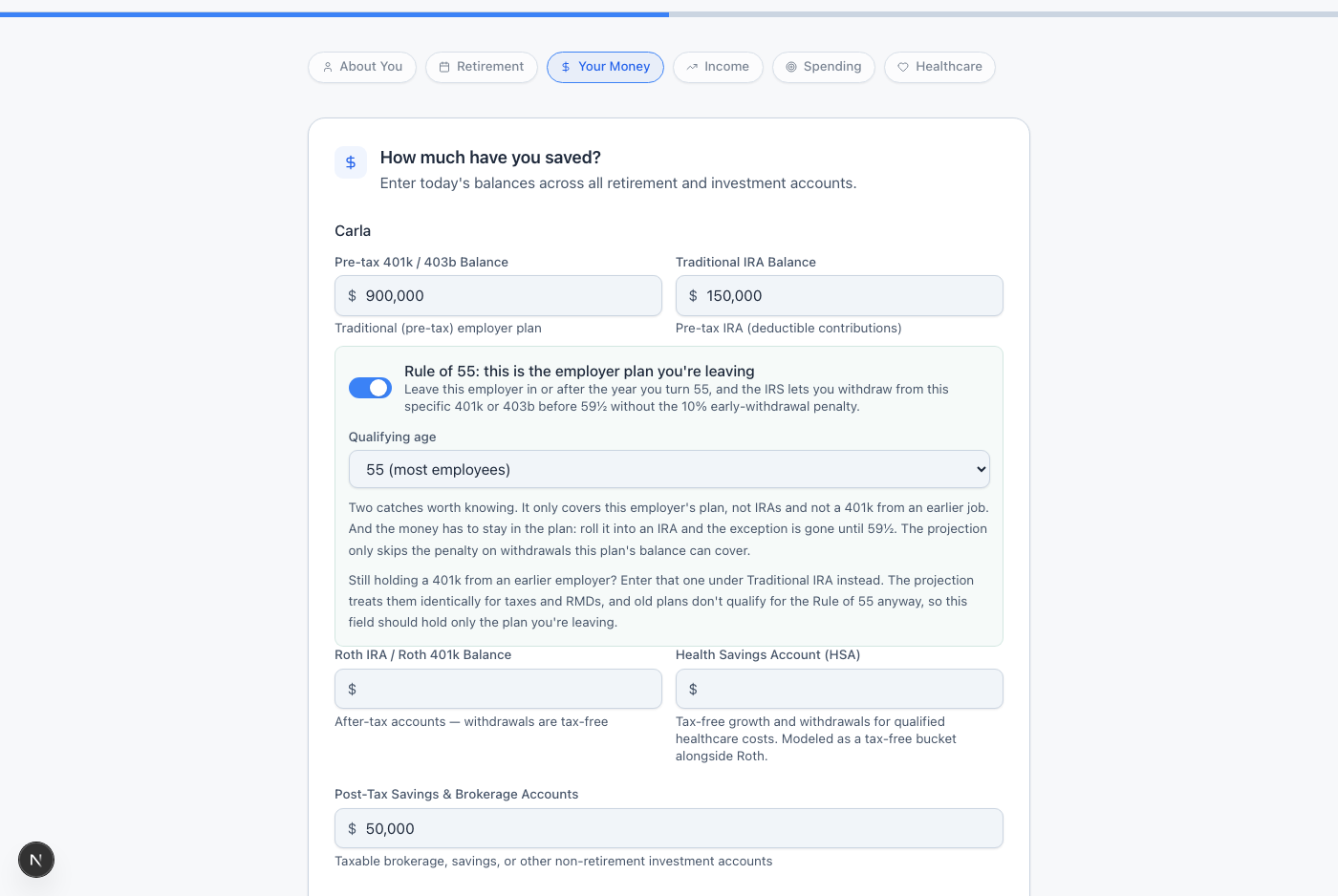
The distinction changes what her first four years of retirement should actually look like. Between 56 and 59½, her plan should draw from the $900,000 first, since that money comes out penalty-free. The $150,000 IRA should mostly sit untouched until 59½, since every dollar pulled from it early costs 10% on top of the tax she would owe anyway. A plan that cannot tell these two pots apart would either withdraw from both at random, quietly adding penalties Carla never needed to pay, or refuse to model any early withdrawal at all.
The Sequencing Mistake This Sets Up
The most common way people lose this exception is not ignorance. It is consolidation. Rolling old accounts into one IRA is good, ordinary advice most of the time (fewer statements, simpler RMDs, easier rebalancing). But if Carla had rolled her current 401k into an IRA before retiring, thinking she was tidying up her accounts, she would have converted $900,000 of penalty-free money into money that costs 10% to touch before 59½.
The old 401k from her prior job never had this option to lose. It was already ineligible the day it left that employer's plan. So there was no reason not to roll it into an IRA years ago, and no reason to treat it differently from any other IRA dollar today. The 401k she is walking away from this year is the only account where the timing of a rollover actually matters.
The rule to hold onto is simple. If you are retiring at 55 or later and might need that money before 59½, leave your current employer's 401k exactly where it is until you know how much of it you will actually need penalty-free. Consolidate everything else. Decide on this one account last.
One More Detail: the Age Is Sometimes 50, Not 55
IRC section 72(t)(10) lowers the qualifying age to 50 for qualified public safety employees, including state and local police, firefighters, and emergency medical services workers, plus federal law enforcement, customs and border protection, federal and private-sector firefighters, and air traffic controllers. Everyone else uses 55. It is a per-account setting, not a guess, since applying the wrong age either overstates penalty-free access or understates it by five full years.
Not financial advice
This article is for informational purposes only. Nothing here constitutes financial, tax, or legal advice. Early-withdrawal penalty rules can change, and plan-level details like vesting and distribution options vary by employer. Always consult your plan administrator or a qualified professional before making withdrawal decisions.
See which of your accounts actually qualify
ThunderHarbor tracks the Rule of 55 per account, so your projection knows exactly which dollars are penalty-free and which are not.
Start your free plan