
July 15, 2026
A 72(t) SEPP Plan Locks You In for Years. Here Is How to Pick the Right One.
If most of your money is in a traditional IRA and you need it before 59½, a 72(t) SEPP plan is usually the only legal way in without a penalty. It comes with three different ways to calculate the payment, and one commitment you cannot undo once you start.
Three Methods, Three Very Different Payments
The RMD method recalculates your payment every year, using that year's balance divided by a life expectancy factor. It produces the smallest payment of the three, and it moves with the market, since a lower balance next year means a lower payment next year.
The fixed amortization method and the fixed annuitization method both calculate the payment once, at the start, using your balance, a life expectancy factor, and an interest rate capped at 120% of the federal mid-term rate. The two methods use slightly different mortality assumptions, but land on nearly identical numbers in practice. Both produce a payment well above the RMD method, and both stay fixed for the life of the plan, regardless of what the market does afterward.
Case Study: Priya, 50, Retiring Almost a Decade Before 59½
Priya is 50, single, and lives in California. Her retirement savings, $450,000, sits in a traditional IRA, with another $50,000 in a taxable brokerage account. She plans to spend $48,000 a year and will not claim Social Security until 67.
At 50, Priya is 9½ years from 59½, well past the five-year minimum. Her commitment period is set by her age, not the five-year floor. Once she starts, she is locked in until she turns 59½, a full decade of fixed obligation.
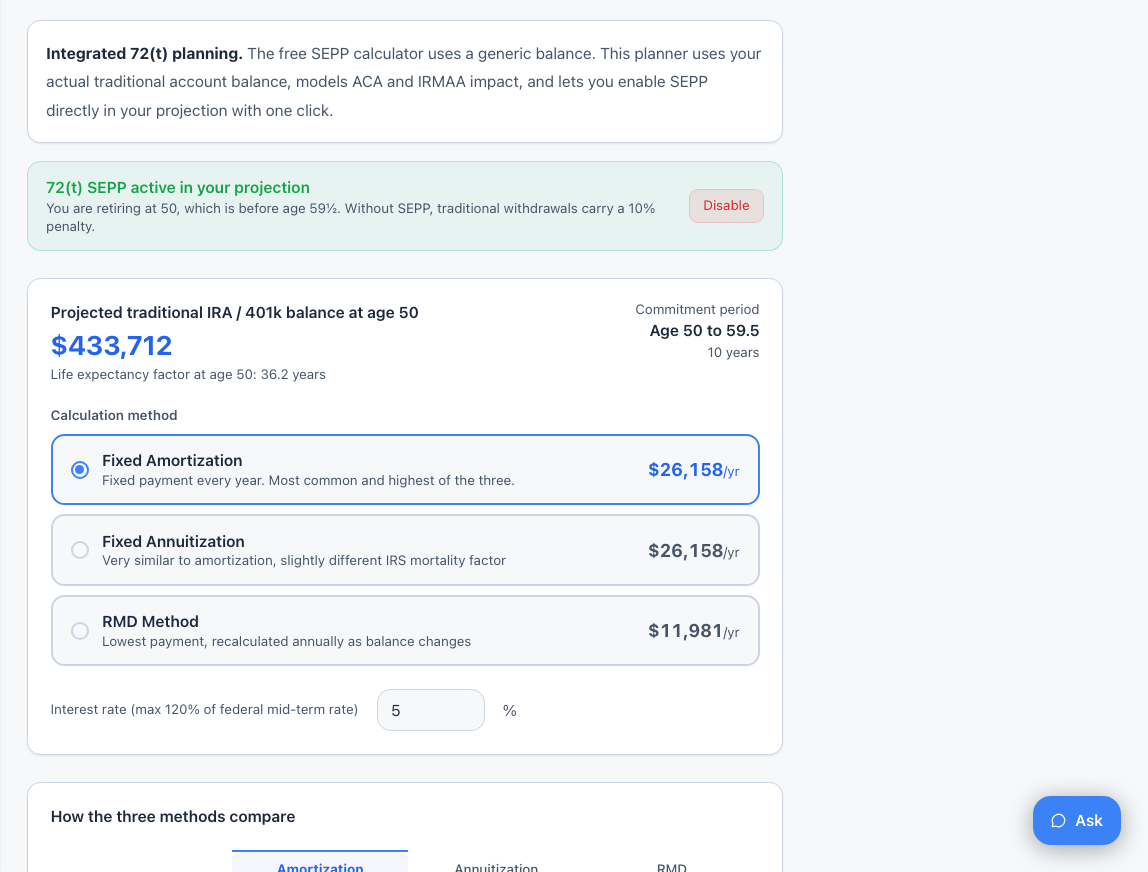
The gap between methods is the real decision here. At $11,981 a year, the RMD method does not come close to covering Priya's $48,000 spending need, and she would have to draw the rest from her $50,000 brokerage account, which will not last a decade. At $26,158 a year, fixed amortization covers more than half of her spending on its own, with the brokerage account and part-time income filling the remaining gap. For Priya, the larger, fixed payment is not a preference. It is the only one of the three that makes her plan work at all.
The Real Cost Is the Commitment, Not the Math
The calculation is the easy part. The hard part is that once Priya starts, she cannot change the amount or stop early for any reason, a market crash, a job offer, an inheritance, without the IRS retroactively applying the 10% penalty to every payment she already took, plus interest, back to the day she started. There is no partial credit for the years she did comply.
That is a ten-year bet for Priya, longer than most people expect when they first hear "five-year rule." The five-year minimum only binds if you are already close to 59½, the way Denise was in her late 50s. Anyone starting a SEPP plan in their late 40s or early 50s is really signing up for however many years stand between their age and 59½, five-year minimum or not.
A Way to Lower the Stakes: Splitting the IRA
Someone with a much larger IRA does not have to commit the entire balance to a SEPP plan. The IRS allows a traditional IRA to be split into two separate IRAs through a trustee-to-trustee transfer before the SEPP plan starts, with the schedule then run on only one of them. The other account is untouched by the commitment and can be tapped or left alone freely, subject only to the normal 10% penalty on its own early withdrawals.
This only helps if the SEPP-only account can still cover what you actually need each year. Sizing that carve-out correctly, large enough to fund your spending, small enough to keep the rest of your IRA flexible, is worth working through with a professional before either transfer happens, since undoing it after the fact is not an option.
Not financial advice
This article is for informational purposes only. Nothing here constitutes financial, tax, or legal advice. 72(t) SEPP rules, interest rate caps, and IRS-approved life expectancy tables change over time. Always consult a qualified professional before starting a SEPP plan, since the commitment cannot be undone once payments begin.
Compare all three SEPP methods against your own balance
ThunderHarbor's SEPP Planner uses your actual projected balance at the year you start, not a generic estimate, and shows how each method changes the rest of your plan.
Start your free plan