
July 18, 2026
NIIT Is Not Just for High Earners. One Big Year Is Enough.
The Net Investment Income Tax gets treated like a high-earner problem, something that only applies to households with permanently large incomes. That framing misses the households it actually catches most often, the ones with one unusually large year.
A Threshold That Has Not Moved Since 2013
NIIT is a 3.8% surtax on investment income, capital gains, dividends, interest, and rental income, once your MAGI crosses $250,000 married or $200,000 single. The tax applies to the lesser of your net investment income or the amount your MAGI exceeds the threshold, whichever is smaller.
Almost every dollar figure in the tax code gets adjusted for inflation each year, the standard deduction, the tax brackets, the capital gains brackets. NIIT's threshold is the exception. It has stayed at $250,000 and $200,000 since the tax was created in 2013, with no adjustment, ever. In real terms, that threshold gets a little lower every year, which means a little more of a household's income counts as "high" by NIIT's standard than did a decade ago, without anyone's actual income changing at all.
Case Study: Everett and Robin, a Modest Year With One Exception
Everett is 63 and Robin is 62. They are married, live in Florida, retired last year, and plan to spend $70,000 a year. Their income most years is unremarkable, Social Security has not started yet, and their withdrawals are sized to cover ordinary spending. This year, they sold a rental property for a $300,000 capital gain.
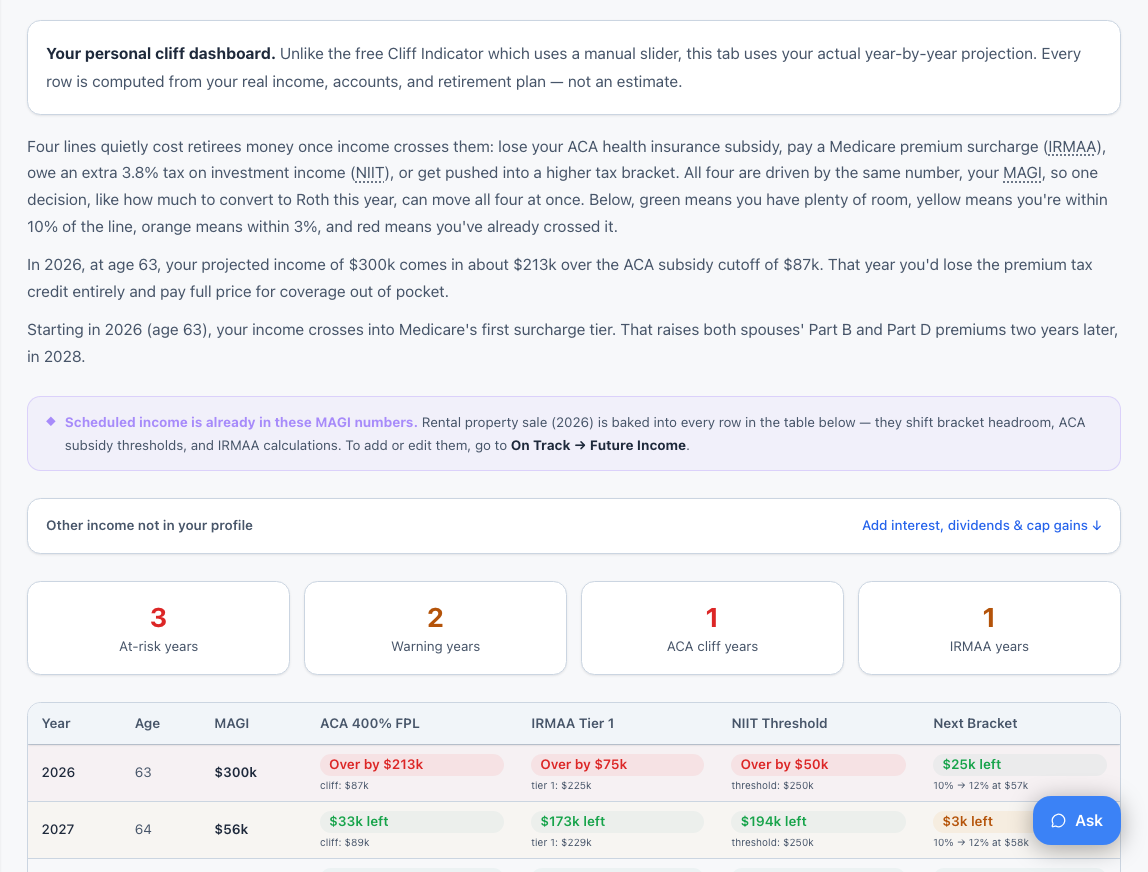
The rental sale is the only thing unusual about their year, and it is enough on its own. Their $300,000 MAGI clears the $250,000 NIIT threshold by $50,000. The same number clears the ACA subsidy cliff by $213,000, meaning they lose their premium tax credit entirely that year, and crosses the first Medicare IRMAA tier by $75,000, which raises both of their Part B and Part D premiums two years later, in 2028. None of these four lines cares whether the income was a one-time event or a permanent raise. They all react to the number in front of them.
The tax bracket line tells a different story, and it is worth noticing why. Everett and Robin still have $25,000 of room before their next bracket jump, since a large share of their $300,000 is taxed as a capital gain, not ordinary income, and capital gains use their own, separate brackets. NIIT does not care about that distinction. It is one of the few thresholds in the tax code that treats a big capital gains year exactly like a big ordinary income year, since both raise MAGI by the same amount.
Why This Belongs in the Planning Conversation, Not Just the Tax Return
None of the four cliffs on Everett and Robin's dashboard, ACA, IRMAA, NIIT, and the next tax bracket, are separate problems. They are all downstream of the same MAGI number, which means the same decision, how much of a gain to realize this year versus next, moves all four at once. A plan that only checks the ordinary tax bracket before a big sale would have told Everett and Robin they had room to spare, since $25,000 of bracket headroom sounds like room. It would have missed the $50,000 NIIT bill and the $213,000 of lost ACA subsidy sitting right behind it.
Spreading a large gain across two tax years, or timing it around a year with lower other income, is a real lever when the sale date has some flexibility. It only works if someone is checking the NIIT threshold specifically, not assuming a household with a normally modest income has nothing to worry about there.
Not financial advice
This article is for informational purposes only. Nothing here constitutes financial, tax, or legal advice. NIIT, ACA subsidy, and IRMAA thresholds are set by current law and can change. Always consult a qualified tax professional before timing a large capital gain or other one-time income event.
See how a one-time gain moves all four cliffs at once
ThunderHarbor's Tax Cliffs tab checks NIIT, ACA, IRMAA, and your tax bracket against your real year-by-year projection, not a single snapshot.
Start your free plan