
October 3, 2026
Roth or Traditional? Three Households Ran the Same Test and Got Three Different Answers.
Should new 401k money go to Roth or to traditional? The usual answer is Roth if you expect a higher bracket later and traditional if you expect a lower one. We ran three households through the same test and got three different answers. One finished far ahead by staying traditional. One finished in a tie. One finished ahead by going all Roth.
What the bracket rule leaves out
The bracket rule is fine as far as it goes. It leaves out two things, and both change the answer.
The first is that the rule compares two different rates. A traditional deduction saves tax at your top bracket today. Withdrawals later do not all come out at the top. Each year's income fills the brackets from the bottom. The first dollars face 10% and 12%, and the standard deduction covers the first $32,200 of a married couple's income outright. The rate you give up later is an average. The rate you save now is your top rate.
The second is that Roth costs real money now. A dollar into Roth takes more out of your paycheck than a dollar into traditional, because you pay the tax up front. If you compare only the two accounts, Roth looks free. To compare fairly, we gave the traditional side the tax it saves each working year and put that money in a taxable account. It earns the plan's returns and pays tax on its gains. Every split then leaves the household the same take-home pay.
Each household below runs five splits through its full plan, from all traditional to all Roth. Roth conversions stay on the app's default setting. We rank the splits by after-tax wealth at the end of the plan, and any split within 2% of the leader counts as a tie. The Plan Optimizer tab shows the result in a card like the ones below. Dollars in the screenshots are future dollars.
Case Study: Tess and Daniel Are Early, and Most of Their Savings Are Still Ahead
Tess and Daniel are 34 and 33 and live in Texas. They earn $110,000 and $70,000. They have $140,000 saved in two 401ks. Together they put in $28,000 a year, all traditional. They plan to stop working at 65 and spend $80,000 a year in today's dollars. Their top bracket is 22%, and it stays 22% whichever way they split.
Going all Roth still costs them. Their federal tax in year one rises from $15,780 to $21,940, which is $6,160 more. Over 31 working years the extra tax adds up to about $191,000.
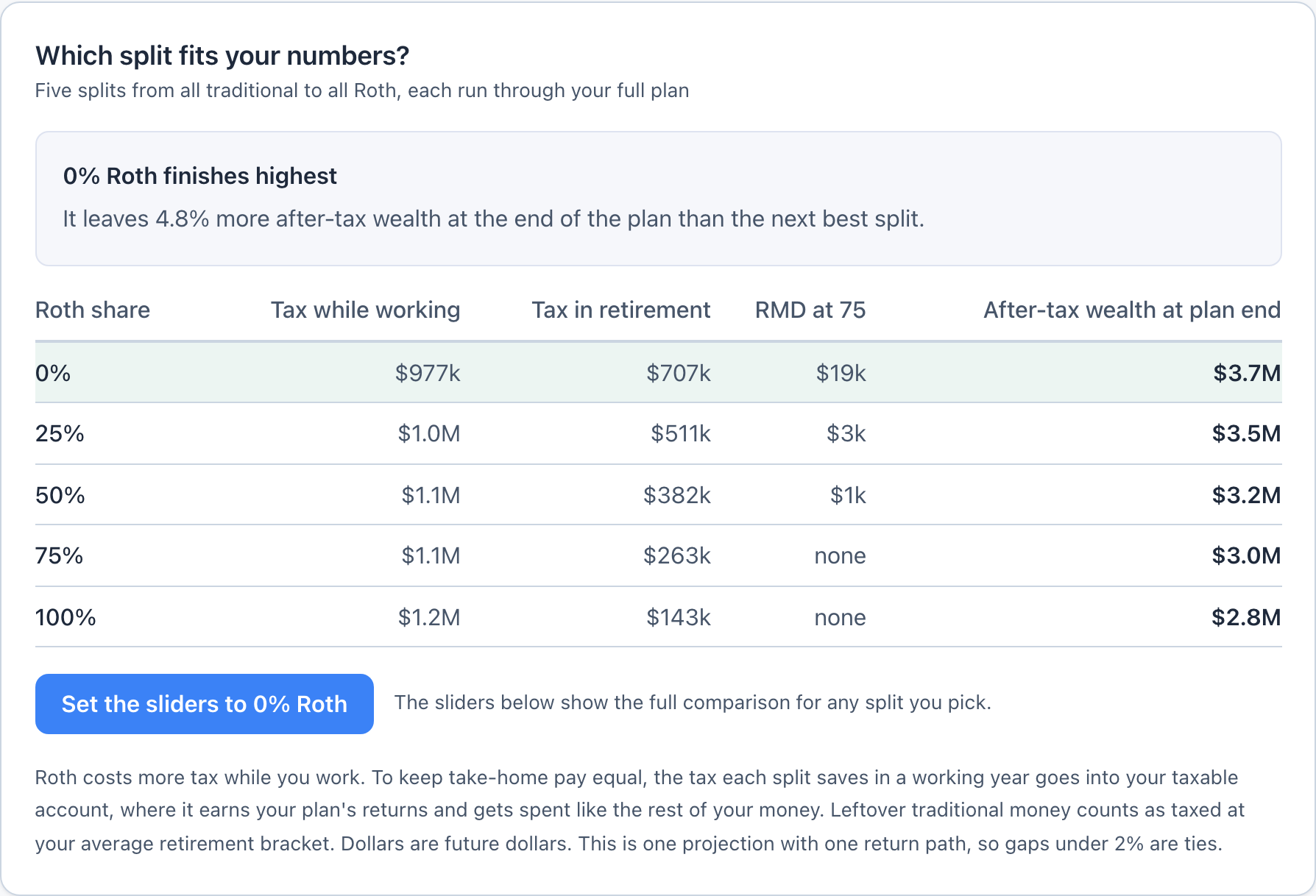
All traditional finishes ahead, and each step toward Roth costs more. A 25% Roth share ends 4.8% behind. A 50% share ends 12.7% behind. All Roth ends 25.7% behind. The smaller retirement bill does not make up for it. Tax in retirement falls from $707,000 to $143,000, a saving of about $564,000. That saving arrives decades after the $191,000 they paid while working.
Two things drive this. Tess and Daniel have yet to contribute most of their future wealth, so the deduction touches nearly all of it. And their retirement years fill the low brackets first, which means their withdrawals cost less on average than the 22 cents the deduction saves on each dollar.
Case Study: Anil and Mei Earn Enough That the Switch Changes Their Bracket
Anil and Mei are 45 and 43 and also live in Texas. They earn $285,000 and $190,000. They have $1.5 million and $800,000 in traditional 401ks, a $100,000 Roth IRA, and a $250,000 brokerage account. Each puts $24,500 a year into a 401k. Both plan to stop working at 62, and they spend $140,000 a year in today's dollars. They worry about the RMDs that arrive at 75. Should every new dollar go to Roth?
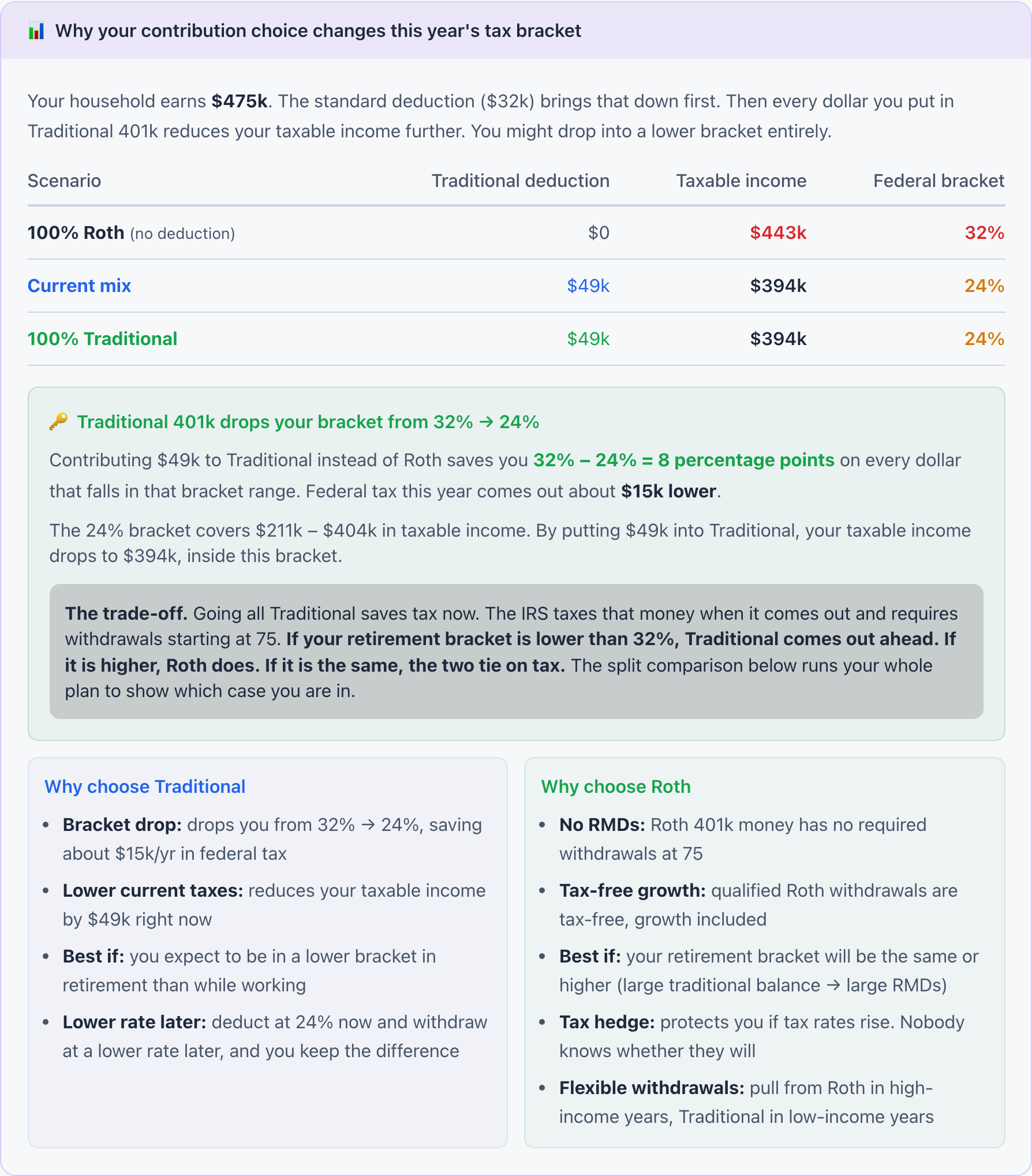
Going all Roth costs them $14,900 more federal tax in year one, $94,608 against $79,708. Across 17 working years it adds up to about $265,000. In return, their first RMD at 75 falls from $309,000 to $245,000. Tax in retirement falls from $3.5 million to $2.5 million.
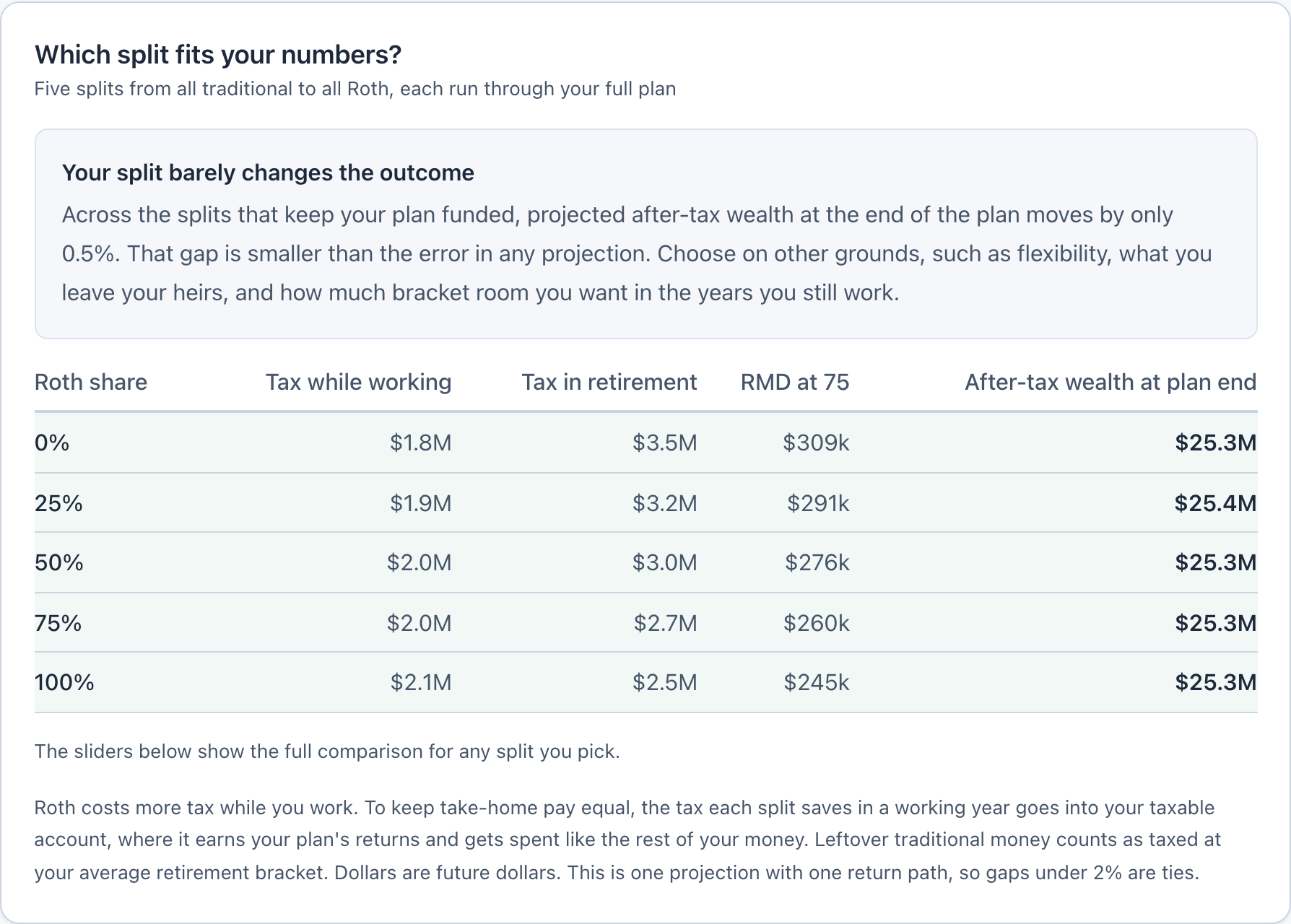
The five splits finish within 0.5% of each other. A 25% Roth share finishes highest, 0.4% ahead of all traditional. That gap is smaller than the error in any projection.
Two forces cancel here. Roth costs them a bracket jump now, 32% against 24%. It also saves them tax later, because $2.3 million is already enough to push their RMDs into high brackets. Neither side wins. They can choose on other grounds, such as how much they want in Roth for their heirs.
Case Study: Gwen Has the Pile and No Gap Years
Gwen is 52 and single and lives in Texas. She earns $105,000 and has $2.2 million in her 401k. She puts in $24,500 a year, plans to work until 70, and spends $85,000 a year in today's dollars. Her top bracket is 22% either way. A Roth switch still costs her $5,390 more in year one and about $98,000 over 18 working years.
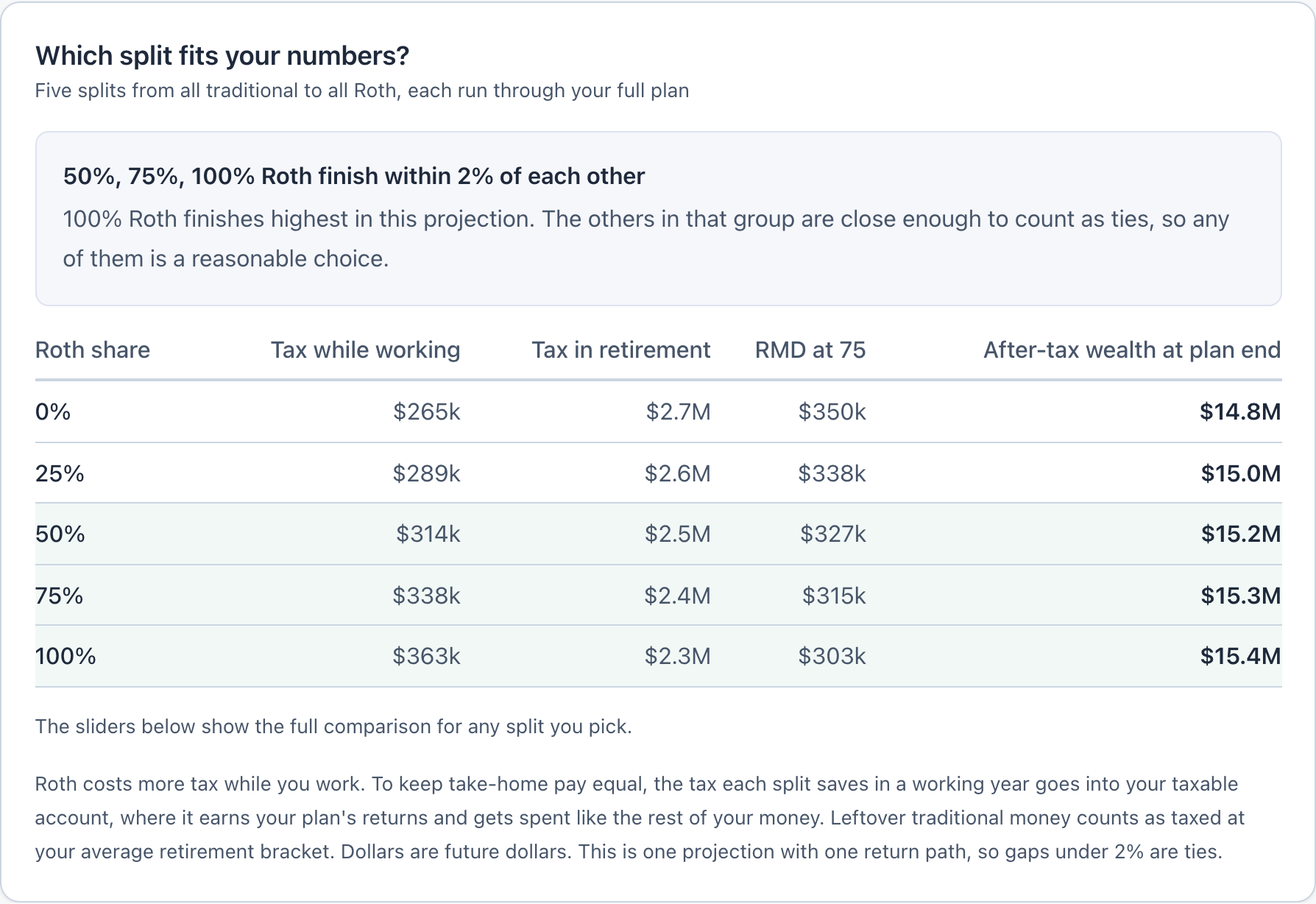
All Roth finishes 4.1% ahead of all traditional. The 50%, 75% and 100% splits finish within 2% of each other. Gwen is the only one of the three whose answer leans to Roth.
Two things work against her deduction. She works until 70, so she has only five years between her last paycheck and her first RMD to convert in. And her $2.2 million grows to about $7.3 million by the time she stops working. Most single brackets are about half as wide as married brackets. Her first RMD at 75 is $350,000 with all traditional. A pile that size fills the low brackets and keeps going, so the 22% her deduction saves now is worth less than the tax she pays later.
What separates the three
| Household | Top bracket now | Years to convert before RMDs | All Roth vs all traditional |
|---|---|---|---|
| Tess and Daniel | 22% | 10 | 25.7% behind |
| Anil and Mei | 24% (32% if all Roth) | 13 | a tie within 0.5% |
| Gwen | 22% | 5 | 4.1% ahead |
Three questions sorted them. The first is where the money will come from. Tess and Daniel's will come mostly from future contributions, so the deduction touches almost all of it. For Anil and Mei and for Gwen, an existing pile does most of the work. New contributions are a small slice.
The second is how many low-income years sit between the last paycheck and the first RMD. Years like those are cheap to convert in. Gwen has five. Tess and Daniel have ten, and Anil and Mei have thirteen.
The third is whether the switch pushes you into a higher bracket. Only Anil and Mei's does. That jump is the part of the cost that a simple bracket comparison hides.
We ran one return path with 3% inflation and the default portfolio. The saved money pays tax on its gains when sold, not on yearly dividends. That favors traditional a little, which is one more reason we treat any gap under 2% as a tie.
Not financial advice
This article is for informational purposes only. Nothing here constitutes financial, tax, or legal advice. The households are hypothetical. Markets and tax law will differ from our assumptions. Your own bracket, state, and goals change the answer. Talk to a tax professional before you change your contributions.
Run the same five splits on your own numbers
The Plan Optimizer tab in ThunderHarbor runs this comparison on your plan and tells you when the answer is a tie.
Start your free plan