
August 20, 2026
A Coast FI Age Is a Prediction, Not a Promise
A coast FI age is one of the more satisfying numbers in retirement planning. It tells you the exact age you could stop contributing to retirement accounts and still get to your number by the time you retire. What it does not tell you, unless you go looking for it, is what happens to that promise if the market spends the next decade doing something other than the average it was built on.
The Number, and What It Is Quietly Assuming
A coast FI age comes from a straightforward test. Take your current savings, apply an assumed average return every year between now and retirement, and find the earliest age at which that growth alone, with no further contributions, still reaches your target. The math is not in question. The assumption underneath it is doing more work than the headline number lets on.
An assumed average return is exactly that, an average. It is not a forecast of what the market will actually do in any specific year between now and retirement. Real returns arrive in an unpredictable order, some years strongly positive, some sharply negative, and the specific sequence you happen to get can leave you meaningfully ahead of the average case or meaningfully behind it, even when the long-run average ends up about right.
Ten Quiet Years
Say someone, call him Dennis, is 50 years old with $2 million saved, planning to retire at 65. A coast FI calculation says he is done. His $2 million, growing at a reasonable assumed average return with no further contributions, comfortably covers his retirement number by 65. Dennis stops contributing. The extra money that used to go into his 401(k) now goes toward paying off his mortgage early and helping a kid through college.
Nothing dramatic happens right away. That is the nature of the risk. Over the next ten years, the market delivers a rougher sequence than the average Dennis's plan was built on, a real decline somewhere in the middle of the stretch, inflation running hotter than assumed for a few of those years, nothing catastrophic in any single year, just a decade that quietly underperforms the smooth line his coast FI age was calculated from. By 60, his balance is well behind where the plan said it would be. By 65, the gap has not closed.
Nobody can point to the day it went wrong. There was no crash, no single bad headline, no decision Dennis can point back to and call a mistake. The plan simply assumed a smooth average, and the next ten years were not smooth. Who does he blame for that? The honest answer is nobody, which is exactly why the number needed a second look before he acted on it, not a villain to find after the fact.
The Question a Single Age Cannot Answer
None of this means the original calculation was wrong. For the average case, it was correct. The problem is that nobody actually lives the average case, they live one specific sequence out of the enormous range of sequences the market could have handed them, and a single coast FI age has no way to tell you where that one sequence falls in the range. It answers "what happens if returns behave," not "what happens if they don't," and the second question is the one that actually matters once real money and a real decade are on the line.
The fix is not a better formula for the age itself. It is asking a different question entirely: instead of one age computed from one smooth average, run that same age through many different simulated market outcomes and see what fraction of them still leave Dennis funded by 65. If the age holds up across the large majority of those outcomes, that is real evidence he can act on. If it only holds up in the better half, that is worth knowing at 50, while there is still a decade left to adjust, not at 63 when there is not.
What the Stress Test Actually Shows
In practice this is a single card, not a separate calculation you have to go build yourself. ThunderHarbor's Risk Analysis tab has a Coast FI Stress Test that starts from the coast age already computed on your plan, then runs that exact age through 1,000 randomized market sequences instead of the one smooth average it came from.
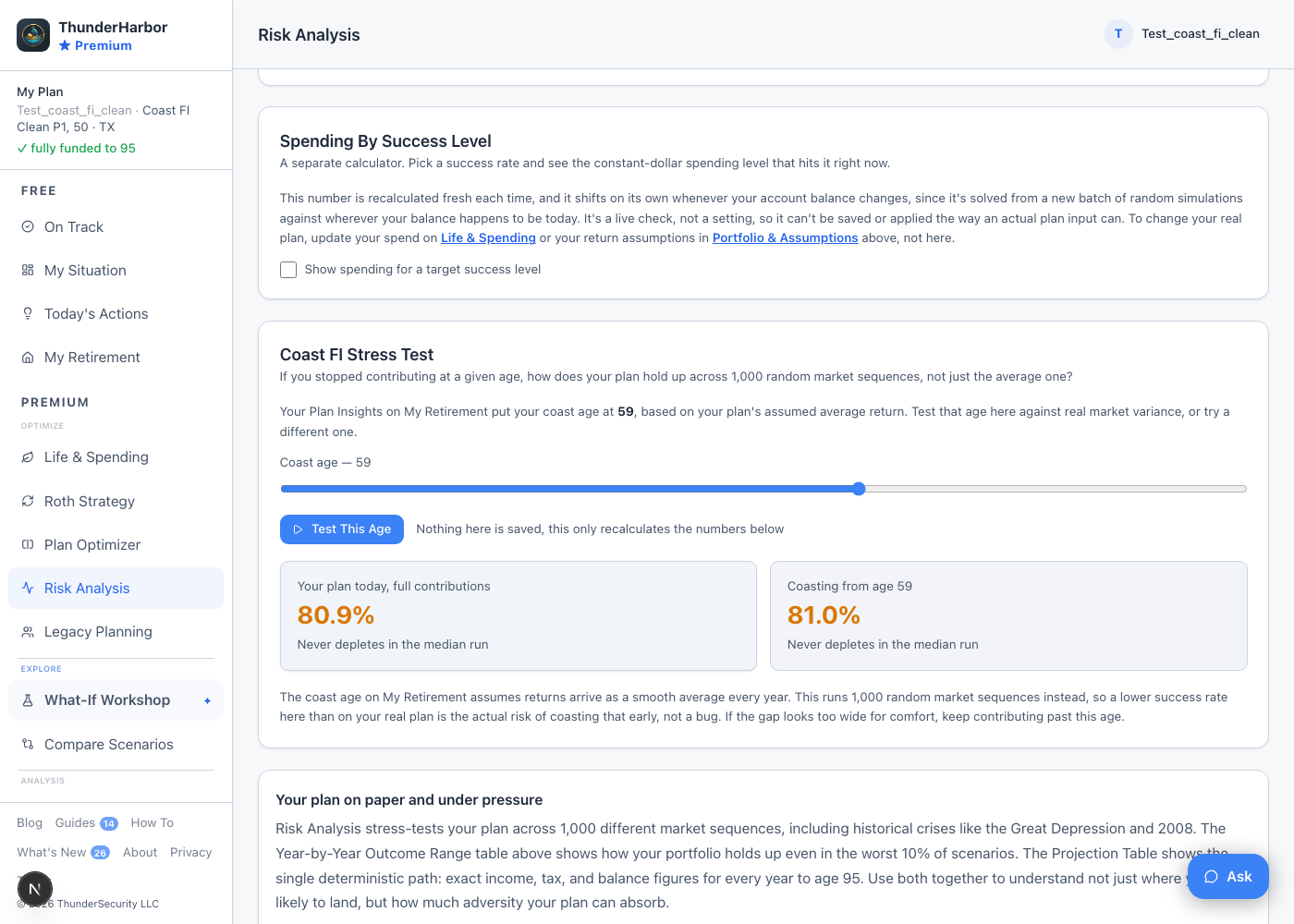
The two numbers side by side are the whole point. One is the success rate for the plan as written, contributions running all the way to retirement. The other is the success rate for stopping contributions at the tested coast age instead. In this example they land close together, 80.9% versus 81.0%, which is what a genuinely safe coast age looks like: stopping early costs almost nothing in the outcomes that actually matter, not just in the single average case.
That gap is not always this small. A coast age computed close to the edge of what someone can actually afford will often show a meaningfully lower success rate once contributions stop, even though the average-case math says it is fine. A lower number here than on the full-contribution plan is not a bug, it is the real cost of coasting that early, made visible instead of hidden inside an averaged formula. If that gap looks too wide for comfort, the honest response is to keep contributing a little longer, not to distrust the tool for telling you.
An Estimate Is Not a Verdict
A coast FI age is genuinely useful. It turns a vague sense of "I think I'm saving enough" into a specific, checkable number, and reaching it is a real milestone worth noticing. The mistake is treating that number as a verdict instead of an estimate, a green light to stop thinking about it instead of a starting point for one more question.
The number is worth having. The stress test is what tells you whether to trust it.
Don't Have a Coast Age Yet? Start With the Free Calculator
If you haven't found your own coast FI age yet, the free coast FI calculator gets you a first estimate in under a minute: enter your current savings, monthly contribution, and target portfolio, and it finds the youngest age the math says you could stop. No account needed.
It uses one flat assumed return and doesn't touch taxes, account type, or guaranteed income like Social Security, which is exactly the smooth-average simplification this whole article has been about. Treat what it gives you as the starting number, then bring it into Risk Analysis, where it runs against your real accounts and 1,000 simulated market sequences instead of one average line, to find out whether it actually holds up.
Not financial advice
This article is for informational purposes only. Nothing here constitutes financial, tax, or legal advice. The example above is illustrative, not a real household. Past market performance does not guarantee future results. Always consult a qualified professional before making significant financial decisions.
Find your coast FI age, then stress-test it
ThunderHarbor calculates your coast FI age from your real accounts, then lets you run that exact age against 1,000 simulated market sequences in Risk Analysis, so you know whether to trust it before you act on it.
Start your free plan