
September 22, 2026
Convert It All or Convert Nothing? Both Cost This Household Six Figures More Than a Third Option
Most Roth conversion advice comes in two flavors. Convert the whole traditional balance before required minimum distributions start, or leave it alone and let it grow tax deferred. We ran both on one household through ThunderHarbor's own engine, then a third strategy that neither camp talks about. Stop converting at the first Medicare IRMAA line instead of a tax bracket. It beat doing nothing by $347,383 and beat converting everything by $132,844, and the reason has almost nothing to do with which tax bracket anyone was in.
Updated September 26, 2026. We fixed a flaw in our projection engine. It had not taken the tax bill on a Roth conversion out of the household's accounts, so it made large conversions look cheaper than they are. The original post said converting everything cost $57,502 more than stopping at the IRMAA line. The corrected figure is $132,844. The gap against converting nothing moved from $348,761 to $347,383. The order of the three strategies did not change.
The two camps, and what they both leave out
"Convert everything" treats the future tax bill on a traditional IRA as a fixed cost you might as well pay now, while rates are known, instead of later, when tax law and RMD size are both guesses. "Convert nothing" treats a Roth conversion as a voluntary tax bill you're paying today for a benefit that might never show up. Both arguments come down to whether to prepay a tax bill. Neither one asks the question that decides the outcome. What does converting this year do to your Medicare premium two years from now?
IRMAA, the income-related surcharge Medicare adds to Part B and Part D premiums, is priced off your tax return from two years earlier. Cross the first threshold by one dollar and both spouses pay the surcharge, for the full year, not only on the dollar that crossed the line. A conversion sized to a tax bracket has no idea that line exists. A conversion sized to stop at the line does, and for a lot of households, that line sits below the tax bracket most conversion advice already recommends filling.
Curtis and Yvonne, three strategies, one household
Curtis, 63, and Yvonne, 61, both retire this year in Washington, which has no state income tax, so every dollar compared below is federal. Between them they hold $2.5 million in traditional 401(k)s and $900,000 in a taxable brokerage account, large enough on its own to cover their spending through the bridge years without ever touching the traditional balance early, so it compounds untouched until required minimum distributions force the issue. Curtis, the lower earner, claims Social Security now. Yvonne delays to 70. They spend $140,000 a year. Nothing about their spending, their accounts, or their Social Security changes between the three strategies below. Only the Roth conversion policy changes.
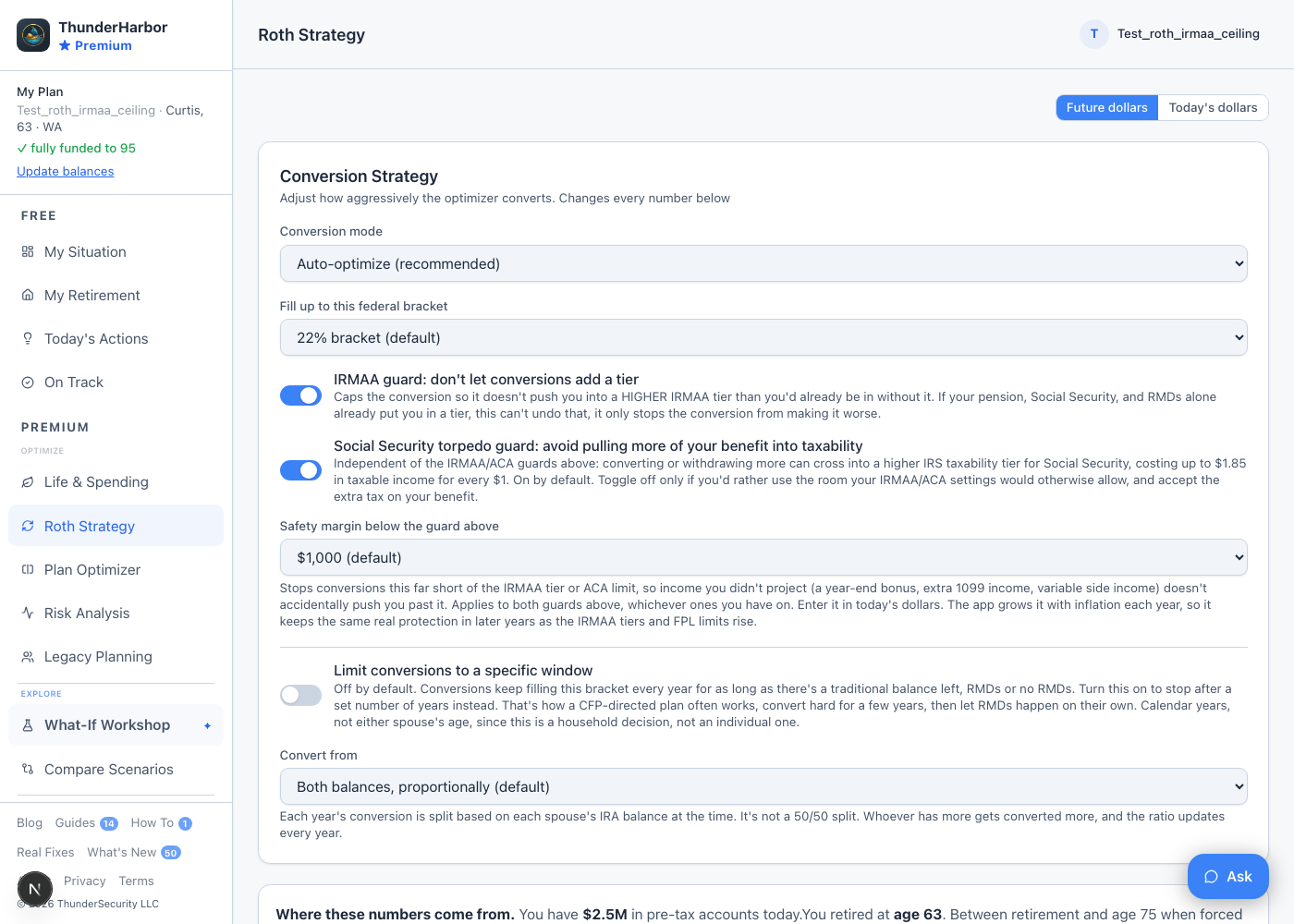
The top of the 22% bracket for a married couple in 2026 works out to about $243,600 of gross income after the standard deduction. The first Medicare IRMAA line for a married couple that same year sits at $218,000 of MAGI. The bracket target is higher than the IRMAA line, so with the guard on, the IRMAA line is what stops the conversion every year, years before the bracket would have. Filling to the 22% bracket and stopping at the Medicare line turn out to be the same strategy for this household, and for most married households in the same position.
What each strategy costs
We ran the household's current plan, which fills to the 22% bracket with the IRMAA guard on, against two saved alternatives. One converts nothing at all. The other converts as aggressively as the top federal bracket allows, with the IRMAA and ACA guards both switched off. Same accounts, same spending, same Social Security, same engine, run side by side.

The current plan is not perfectly clean. It still crosses the surcharge line in two years, by about $1,200 a year. The household sells brokerage shares to pay each conversion's tax bill, and the gain on those shares adds a little income the conversion did not count. Two small surcharges are still far cheaper than either alternative.
Converting nothing cost this household $347,383 more in lifetime tax than stopping at the IRMAA line, the largest gap of the three strategies. Leaving the traditional balance alone let it compound untouched for over a decade, so by the time required minimum distributions started at 75, the balance had grown large enough to force a $125,000 withdrawal in that first year alone, taxed on top of Social Security, with RMDs continuing and growing every year after. Fifteen years of the household's remaining plan crossed the Medicare surcharge line too, a cost the household never chose and could not time around, since RMDs arrive whether or not the cash is needed that year and stack directly on top of whatever else is already taxable. "Let it grow tax deferred" sounds conservative. Against this household's own numbers, it was the single most expensive of the three strategies.
Converting everything up front cost $132,844 more in lifetime tax than stopping at the IRMAA line, still worse, only by a smaller margin than doing nothing. Pushing $2.5 million through mostly the top federal brackets in a short window does exactly what it sounds like. The household pays a high marginal rate on money that didn't need to be taxed that fast, and picks up a year of Medicare surcharges it would not have owed otherwise. Nothing about "converting early while rates are known" changes that arithmetic. The size of the check matters as much as the fact that it was written early.
The size of the gap depends on the household. The direction doesn't
$347,383 is specific to Curtis and Yvonne's numbers, a traditional balance large enough, and spending modest enough, that it compounded for over a decade before RMDs touched it at all. A household with a smaller traditional balance relative to its spending, or one that draws down that balance earlier for ordinary income needs, will see a smaller gap than this one. What won't change is the direction. Converting past your own safe ceiling, whether that ceiling comes from a tax bracket or a Medicare threshold, reliably costs more than converting up to it. Doing nothing reliably trades a chosen tax bill now for a forced one later, sized by a formula that has never once asked what the household needed that year, and that formula gets more expensive the longer a large balance is left to compound before it's finally forced out. Between those two costs sits a stopping point most conversion advice never mentions, because it isn't written into the tax code the way a bracket is. It's written into Medicare's.
Not financial advice
This article is for informational purposes only. Nothing here constitutes financial, tax, or legal advice. Curtis and Yvonne are an illustrative example, not real customers. IRMAA thresholds, tax brackets, and the standard deduction adjust most years and depend on your filing status and state of residence. Always consult a qualified professional before making significant financial decisions.
See where your own IRMAA line falls
The Roth Strategy tab sizes your conversion against the real Medicare and ACA thresholds every year, not only a tax bracket, and Compare Scenarios shows the difference against doing nothing or converting everything, using your own numbers.
Open ThunderHarbor