
May 23, 2026
In Retirement Your Income Is a Choice: How to Engineer Your MAGI
This article is specifically for people planning to retire before age 65, the point when Medicare begins. If you earned $200,000 or more during your career, you have probably assumed that ACA health insurance subsidies simply do not apply to you. The subsidy cliff sits around $82,000 for a couple in 2026. Your salary was two or three times that. The gap looks impossible to cross. What almost no one tells high earners is this: your salary disappears the day you retire, and the income that now determines your ACA subsidy is not what you used to earn. It is what you choose to withdraw, from which account, in each year before Medicare. That choice can be worth $20,000 or more per year.
What Actually Counts as Income in Retirement
The number that determines your ACA subsidy, your IRMAA Medicare surcharges, and your exposure to the 3.8 percent Net Investment Income Tax is called MAGI. It stands for modified adjusted gross income. During your working years, MAGI is essentially your salary plus investment income and you have almost no control over it. Retirement breaks that direct link between what you spend and what the IRS counts as your income.
Here is what counts toward MAGI in retirement. Traditional IRA and 401k withdrawals count as ordinary income, dollar for dollar. Roth conversions count as ordinary income. Social Security counts at 85 percent once your other income passes certain thresholds. Dividends, interest, and capital gains from a taxable brokerage account count. Pension income counts.
Here is what does not count. Roth IRA and Roth 401k withdrawals are completely invisible to the IRS and do not affect MAGI at all. HSA distributions used for qualified medical expenses do not count. Withdrawals of the original principal you contributed to a taxable brokerage account do not count as income. Only realized gains and dividends do.
This distinction is the entire game. A couple spending $150,000 per year in early retirement can have a MAGI of $40,000 or a MAGI of $150,000 depending almost entirely on where they pull the money from. That is the difference between a $90 monthly ACA premium and a $2,400 monthly ACA premium. It is the difference between no IRMAA surcharge and a $5,000 Medicare surcharge. It is the difference between no NIIT and a meaningful surtax on every dollar of investment income.
Case Study: The Couple Who Retired on $280k and Qualified for ACA Subsidies
James and Carol both worked in tech. Combined they earned about $280,000 per year for the last decade of their careers. They maxed their 401ks every year and also saved aggressively in a taxable brokerage account. By 58 they had $1.8 million in traditional retirement accounts, $600,000 in a Roth from years of backdoor contributions, and $400,000 in a taxable brokerage account. They retired together at 58, planning to spend roughly $110,000 per year.
Their first instinct was to assume they would pay full price for ACA health insurance for seven years until Medicare. At their income level while working, the subsidy cliff had never been relevant. But when they sat down to model which accounts to draw from, something surprising emerged.
To generate $110,000 of spending they planned to draw $80,000 from their Roth account and $30,000 from their taxable brokerage principal. The Roth withdrawal counts as zero toward MAGI. The brokerage principal counts as zero. Their only MAGI comes from the brokerage dividends the account throws off passively, which run about $8,000 per year. Their total MAGI: $8,000. Well below the ACA cliff.
The Silver plan for two 58-year-olds at that income level costs them about $90 per month after subsidy. The same plan without any subsidy would cost $2,400 per month. The subsidy saves them roughly $27,600 per year. They qualify not because they are poor but because they planned which accounts to draw from.
This strategy works for James and Carol because they built up substantial Roth and taxable assets over their career. The key point is that people who spent decades earning $200,000 or more can absolutely qualify for ACA subsidies in early retirement. It requires having the right account mix and drawing from tax-free sources first.
Case Study: The Retiree Who Hit All Three Cliffs at Once
Robert retired at 63 with $2.3 million sitting almost entirely in a traditional IRA. He had no Roth and a small taxable brokerage account. To generate $120,000 of spending per year his only real option was to pull from the traditional IRA. Every dollar he withdrew counted as ordinary income.
At $120,000 of withdrawals Robert’s MAGI sat well above the ACA subsidy cliff. He paid full price for health insurance, roughly $1,350 per month as a single 63-year-old. He had no path to a lower number because he had no tax-free bucket to draw from instead.
As his brokerage account grew to $380,000 and started generating meaningful dividends, he crossed something else he had not anticipated: the Net Investment Income Tax threshold at $200,000 for single filers. Because his IRA withdrawals kept his MAGI above $200,000 his $22,000 in annual dividends became subject to an additional 3.8 percent surtax. An extra $836 per year on a line of his return he had never noticed before.
When he turned 65 and moved to Medicare the ACA issue went away but IRMAA took its place. His $120,000 of traditional withdrawals put him into the first IRMAA tier, adding about $1,050 per year in Medicare surcharges.
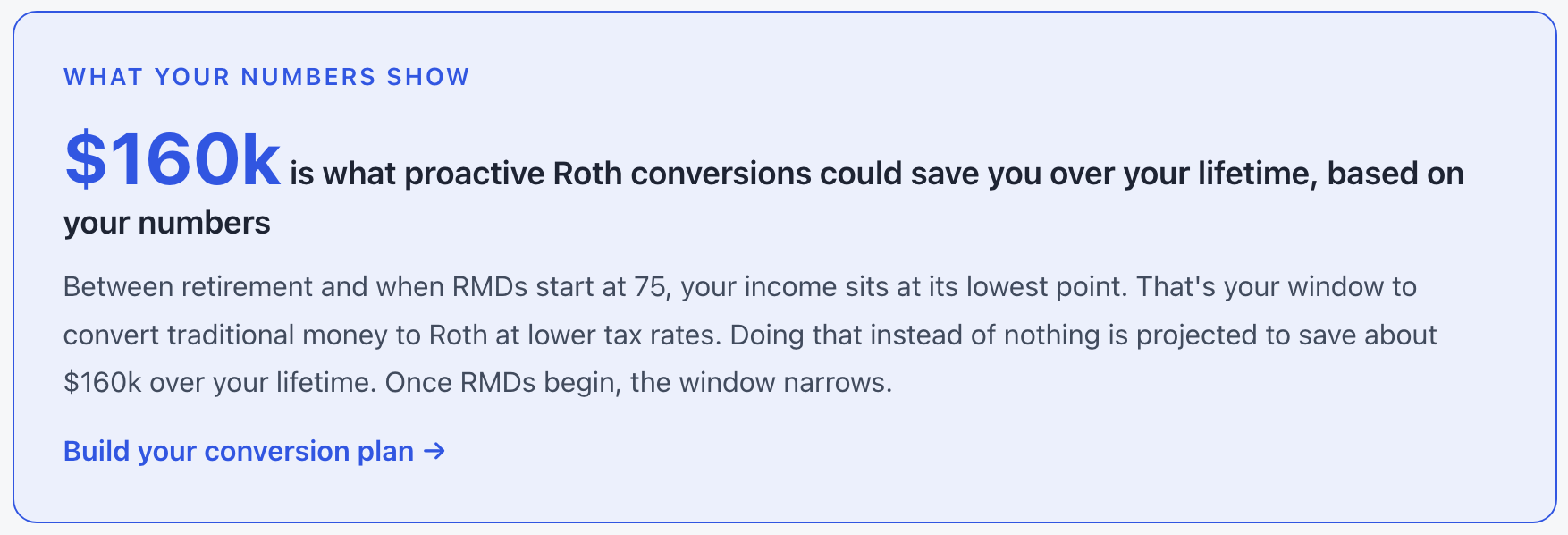
Robert’s situation is not unusual. A traditional-heavy portfolio with no Roth alternative leaves very little flexibility over MAGI in retirement. The time to build that flexibility was during the working years, through Roth contributions or Roth conversions. Our piece on why a massive traditional 401k is a tax problem covers how this plays out across a full retirement in more detail.
Case Study: Engineering MAGI for Seven Years Before Medicare
Linda retired at 58, single, with $900,000 in a traditional IRA, $350,000 in a Roth, and $180,000 in a taxable brokerage. She had seven years before Medicare. Her goal was to keep her MAGI low during those bridge years to maximize her ACA subsidy, then convert aggressively from 65 to 72 before required minimum distributions started.
In years one through four she lived almost entirely on Roth withdrawals and brokerage principal, keeping her MAGI around $18,000 from passive dividends. At that income level she qualified for a very substantial subsidy and paid about $45 per month for a Silver plan that would have cost her over $1,100 unsubsidized as a 59-year-old.
In years five through seven her Roth account was partially drawn down and her taxable brokerage generated more income from positions she sold. Her MAGI drifted toward $45,000. She still qualified for a meaningful subsidy and paid about $280 per month after credits.
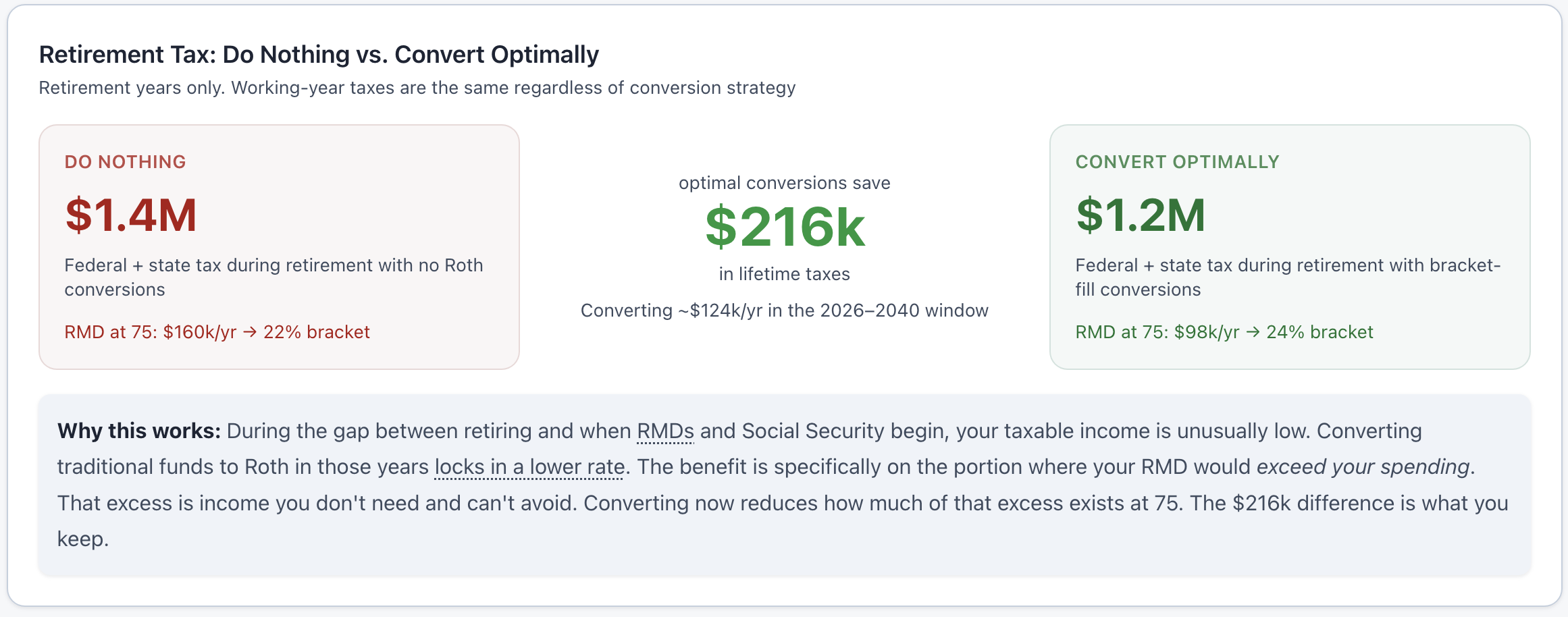
Then at 65, freed from ACA exposure, she converted $60,000 to $80,000 per year from her traditional IRA for seven straight years. By the time RMDs started at 73 her traditional balance had dropped from $900,000 to under $400,000, cutting her forced withdrawals nearly in half and reducing her expected lifetime tax bill by more than $90,000 compared to doing nothing.
Linda’s plan was not complicated. It just required knowing which bucket to pull from in which years and understanding that the bridge period before Medicare is the worst time to take large traditional withdrawals if you have tax-free alternatives available.
The Account Types That Give You Control
To engineer your MAGI in early retirement you need at least one source of spending that does not count toward it. Here are the most useful ones.
Roth IRA and Roth 401k withdrawals are the most powerful tool. Qualified distributions are completely excluded from MAGI with no limit on how much you can withdraw. A large Roth balance gives you genuine control over your reported income in any given year.
HSA accounts used for qualified medical costs are also excluded from income. For retirees with years of accumulated HSA balances this can cover a meaningful chunk of healthcare spending without touching MAGI.
Taxable brokerage principal does not generate income when withdrawn. Only realized gains and dividends count. A well-structured taxable account with a high cost basis can serve as a low-MAGI source of spending for several years, especially early in retirement before significant gains have accumulated.
Traditional 401k and IRA balances give you the least control. Every dollar out counts as ordinary income. The more of your retirement savings that sits in traditional accounts with no Roth alternative, the more of these thresholds you will hit by default rather than by choice.
The NIIT Threshold: A Fourth Cliff Worth Watching
For early retirees holding substantial taxable brokerage accounts there is a fourth threshold worth tracking alongside the ACA cliff, the IRMAA tiers, and the tax bracket boundary. The Net Investment Income Tax adds a 3.8 percent surtax on investment income including dividends, capital gains, and interest once your MAGI crosses $200,000 as a single filer or $250,000 as a married couple.
Unlike the other thresholds, NIIT only applies to investment income specifically, not to IRA withdrawals or Roth conversions. A retiree with $180,000 of IRA withdrawals and $30,000 of brokerage dividends at $210,000 MAGI owes 3.8 percent not on the full $210,000 but only on the $10,000 of investment income sitting above the $200,000 line. That is a $380 bill, not a $7,980 bill.
Where it becomes meaningful is when a Roth conversion pushes your MAGI across the threshold. A conversion that moves you from $235,000 to $265,000 suddenly exposes $30,000 of your dividend and capital gain income to an extra 3.8 percent. It is rarely the biggest number on the table but it is one that almost no one models in advance.
You can check your own headroom to all four thresholds at once using the free Cliff Indicator. Enter your MAGI and investment income and it shows your dollar headroom to each cliff in real time.
The Simple Sequence That Most People Miss
The years between retiring and turning 65 are the most income-sensitive years of your financial life. ACA subsidies can be worth $15,000 to $30,000 per year for a couple. The difference between engineering a $55,000 MAGI and defaulting to a $130,000 MAGI can exceed $100,000 over a seven year bridge period after accounting for both the subsidies and the tax on the withdrawals themselves.
The sequence that works for most early retirees is straightforward. Draw from Roth and taxable principal first during the bridge years before 65. Keep traditional withdrawals small or zero during that window if you can. After Medicare starts at 65 and the ACA exposure ends, begin larger Roth conversions each year. Do this from 65 to 73 to reduce the traditional balance before required minimum distributions force the issue. Then let the Roth grow untouched for as long as possible.
The reason most people miss this is that traditional retirement planning tools show portfolio survival probability and total tax bills in isolation. They do not show the interaction between which account you draw from, what that does to your MAGI, and what that MAGI costs you in health insurance premiums across the bridge years. Those three things have to be modeled together or the plan is incomplete.
The one-sentence version: use tax-free accounts first in the years before Medicare, use traditional accounts and do large conversions after Medicare, and know your MAGI cliffs well enough to make those decisions intentionally rather than by accident.
Not financial advice
This article is for informational purposes only. Nothing here constitutes financial, tax, or legal advice. ACA subsidy rules, IRMAA thresholds, NIIT limits, and tax brackets change from year to year. Always consult a qualified professional before making significant financial decisions.
See all four cliffs against your actual numbers
ThunderHarbor models ACA subsidies, IRMAA surcharges, NIIT exposure, and tax bracket headroom together year by year so you can see exactly how your withdrawal decisions affect your total retirement cost.
Start your free plan