
September 11, 2026
Spending Brokerage First Is the Default in Every Calculator. It Isn’t Always the Cheaper Choice.
Every retirement calculator assumes the same withdrawal order without asking whether it fits you. Spend the taxable brokerage account first, since long-term capital gains rates are usually lower than ordinary income tax. Let the traditional IRA keep compounding tax-deferred. Spend Roth last. For most households in most years, that order is a fine default.
For Priya, a real household we walk through below, it was quietly worth about $100,000. Nothing about her plan was wrong. The order itself was pointed the wrong way for her numbers, and only for one part of her plan.
The Assumption Nobody Checks
The reasoning behind brokerage first is sound as far as it goes. Only the gain portion of a brokerage withdrawal counts as income, not the whole amount, and a lot of retirees can realize that gain at a 0% federal rate in their early retirement years. Spending brokerage down first also leaves the traditional IRA untouched longer, letting it compound tax-deferred instead of drawing on it early. Most retirement software, ThunderHarbor’s own Roth Strategy tab included until this week, applies that order everywhere and never asks whether a household might come out ahead the other way.
Priya, With No Roth Conversions at All
Priya is 58, retired, and on Medicare early through a qualifying disability. She has $2.2 million in a traditional 401(k) and $300,000 in a taxable brokerage account, and spends $70,000 a year. She is not running a Roth conversion strategy right now, which makes her the cleanest place to see what withdrawal order does on its own, with nothing else changing.
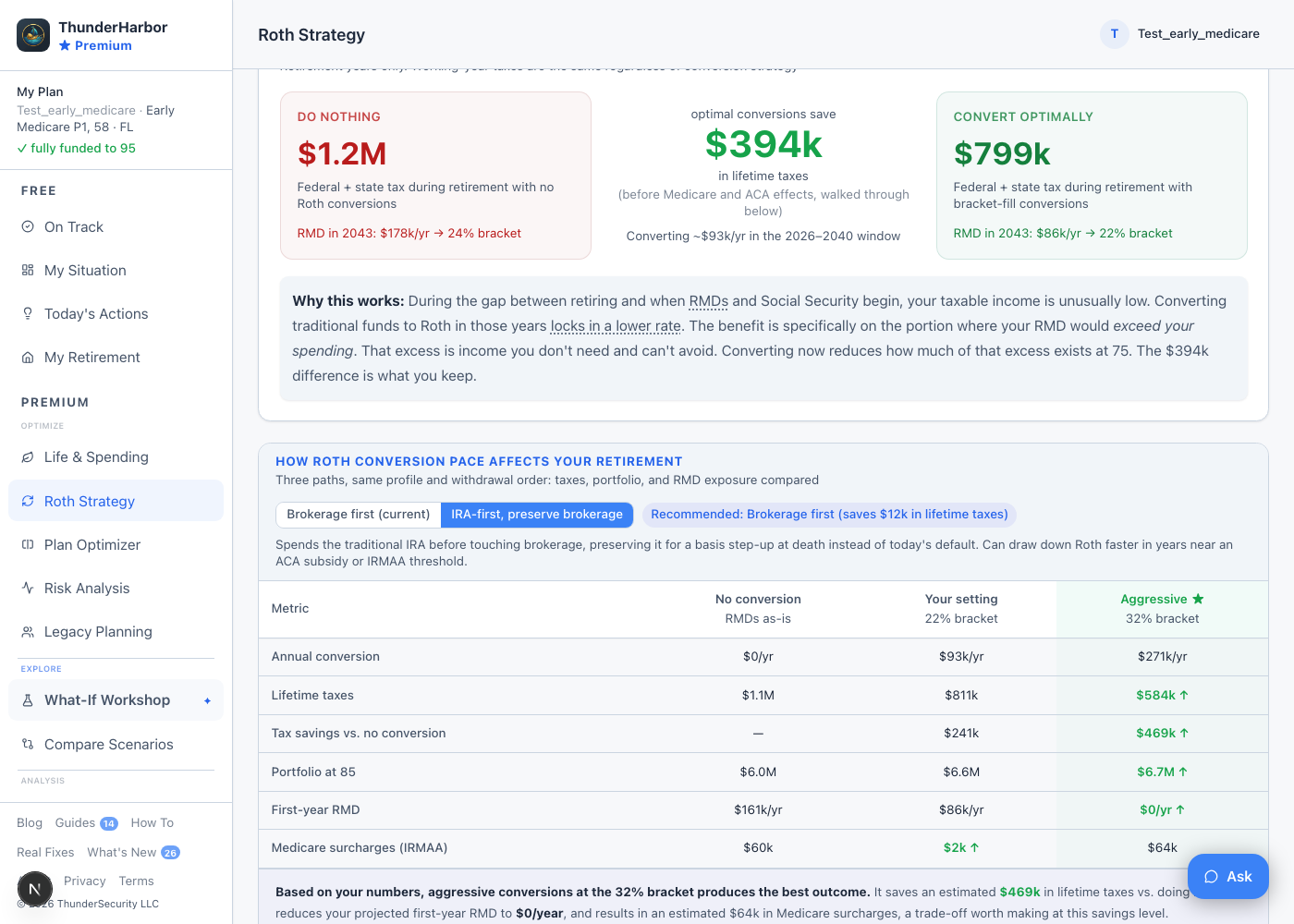
Spending brokerage first, her plan shows $1.2 million in lifetime federal and state tax, a first-year required minimum distribution of $178,000, and $70,000 in Medicare surcharges over her retirement. Spending her traditional IRA first instead and leaving brokerage alone, the same plan drops to $1.1 million in lifetime tax, a $161,000 first-year RMD, and $60,000 in Medicare surcharges.
Nothing about her spending changed. The only difference is which account paid for it. Drawing the IRA down earlier, instead of letting it compound untouched behind a brokerage cushion, leaves a smaller balance by the time required distributions begin. A smaller balance produces a smaller forced withdrawal every year after that, which means less income pushing her into a higher Medicare tier. One order avoids that buildup. The other does not.
The Moment She Starts Converting, the Order Flips
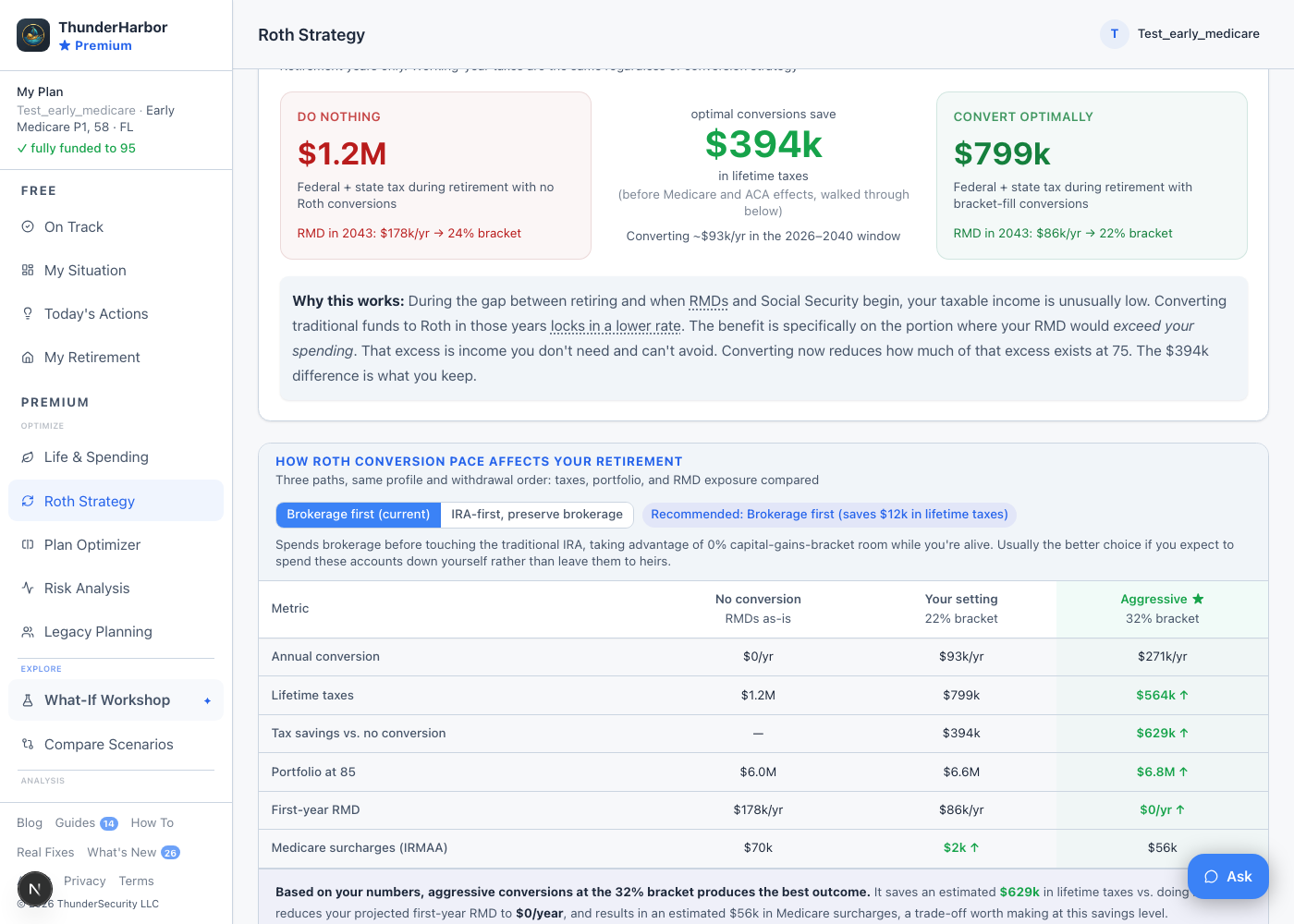
Priya’s actual plan does include Roth conversions, filling the 22% bracket most years. Run the same comparison under her real settings and the order that won above stops winning. Spending brokerage first now costs $799,000 in lifetime tax. Spending the IRA first costs $811,000, about $12,000 more. Push her conversions further, to the 32% bracket, and the gap widens to $20,000 in brokerage first’s favor.
The reason is that her Roth conversions are already doing the job spending the IRA first was doing for her in the no-conversion case, shrinking the traditional balance before required distributions force the issue. Once she is handling that job on purpose, brokerage first’s own advantage, capital gains taxed at a lower rate than ordinary income, takes over again.
Why Some Households Pick IRA First Anyway
None of this means brokerage first is always right once conversions enter the picture. It means the cheaper order depends on what else is happening in the plan, and lifetime tax is not the only thing some households care about most. A brokerage account held until death gets a full step-up in cost basis, and current law forgives whatever gain built up inside it entirely, instead of deferring it, before the account passes to heirs untaxed. A household that expects to leave money behind rather than spend every dollar themselves can have a real reason to spend the IRA first and let brokerage sit, even in a year where it costs a bit more in tax while they are alive.
That is a different question than the one Priya’s numbers answer above. Hers is about her own lifetime tax bill. A household weighing a step-up at death cares most about something else, and the order that fits them can be the one that loses the tax comparison and wins the legacy one.
Two Questions, Not One
We wrote last week about how a fixed withdrawal order tells you which account funds this year’s spending but says nothing about how much to convert or how much brokerage gain to realize while you are at it. Withdrawal order hides a second decision too, whether brokerage first is even the right order to begin with. Neither question has one answer that applies to every household. Both depend on numbers specific to the household asking.
Not financial advice
This article is for informational purposes only. Nothing here constitutes financial, tax, or legal advice. Priya is an illustrative example, not a real customer. Tax brackets, IRMAA thresholds, and RMD ages change most years and depend on your filing status, state, and birth year. Always consult a qualified professional before making significant financial decisions.
See which order wins for your own numbers
ThunderHarbor’s Roth Strategy tab compares brokerage first and IRA first against your actual balances, and tells you which one produces less lifetime tax or which one fits your goals if you have told us leaving a legacy matters to you.
Build my plan