
August 5, 2026
401k, 403b, 457(b): The Three Accounts Most People Actually Retire On
Social Security gets most of the attention in retirement conversations, but for most working people it is not the main event. The main event is whichever employer plan shows up on their pay stub, a 401k, a 403b, or a 457(b), quietly building for decades before anyone thinks hard about it. Done consistently over a full career, that account is realistically what retirement actually rests on. Social Security fills in the rest.
The three plans get treated like interchangeable versions of the same thing. They are not. They share a lot, but the differences change what you can actually do, especially if you ever have access to more than one.
What All Three Actually Have in Common
All three are employer-sponsored, meaning you cannot open one on your own the way you can open an IRA. All three let you defer part of your paycheck before tax, and most plans today also offer a Roth version that you fund with after-tax money instead. All three can come with an employer match, usually on a vesting schedule that requires a certain number of years before the match is fully yours. And the pre-tax balance in any of them is eventually subject to Required Minimum Distributions, starting at 73 or 75 depending on when you were born.
That last point matters more than people expect. Every dollar you defer into any of these accounts is a dollar the IRS will eventually force back out, on its own schedule, not yours. Building the account well is only half the job. What happens to it decades later is the other half, and it is easy to ignore for most of a career.
Where They Actually Differ
A 401k is offered by private, for-profit employers. It is the one most people have heard of, and most of what gets written about employer retirement plans online is really written about this one specifically.
A 403b is offered by nonprofits, public schools, hospitals, and religious organizations. Day to day it behaves almost identically to a 401k, same contribution limit, same early withdrawal penalty before 59½, same RMD rules. The one real quirk is a special catch-up available to employees with 15 or more years at the same organization, letting some long-tenured 403b holders defer a bit more than the standard catch-up allows. Most people with a 403b have never heard of it and never claim it.
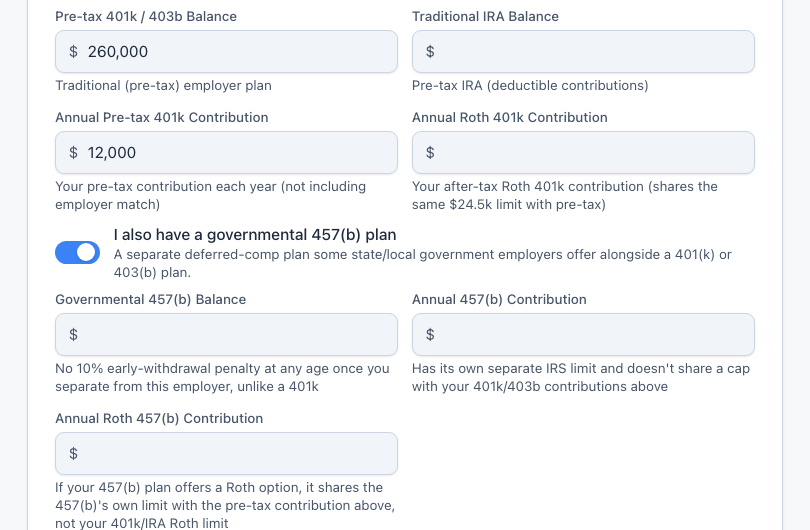
A 457(b) is offered by state and local government employers, and by some nonprofits. This is the one that actually behaves differently, not just on paper. Janet retired from a county government job at 52, with $340,000 in a 457(b) she had been contributing to for 24 years. She assumed she would need the same 72(t) SEPP schedule her husband had set up on his 401k to touch any of it before 59½. She did not. A governmental 457(b) has no early withdrawal penalty at any age once you separate from that employer. No 59½ rule, no Rule of 55 exception needed, no SEPP schedule required to avoid a penalty that was never going to apply in the first place. Janet drew from her balance the year she retired, penalty-free, something her husband could not do with his 401k without a formal plan first.
One caution belongs here. That protection is not a benefit that follows the money once it leaves the plan. Roll a 457(b) into an IRA, or into a 401k or 403b, and it becomes subject to that account’s normal rules from that point forward, including the standard 10% penalty before 59½. The exception is specific to distributions taken directly from an eligible governmental 457(b). Consolidating everything into one IRA for simplicity can quietly close a door you were planning to use.
The Part Almost Nobody Realizes: You Can Max Out Two of Them
A 401k and a 403b share one combined IRS contribution limit. If you somehow had both in the same year, your total deferral across the two is still capped at a single number, not doubled.
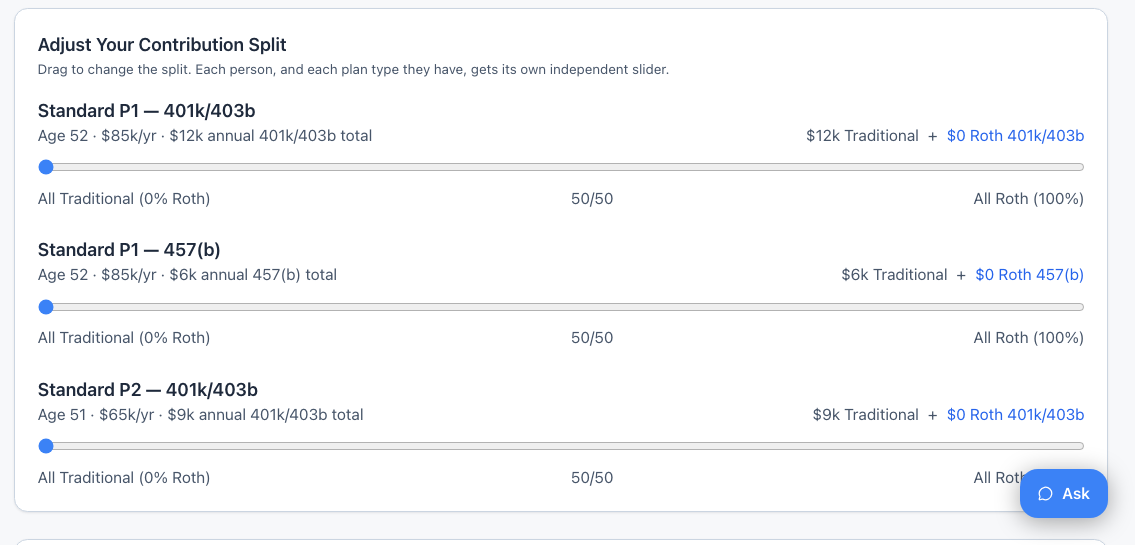
A 457(b) is the exception. Its contribution limit is entirely separate from a 401k or 403b limit, tracked independently. Some public sector employees, teachers with a 403b and a district-offered 457(b), for example, or state employees with both a 401k and a 457(b), can max out both accounts in the same year. That is not a small edge. It roughly doubles the tax-advantaged savings capacity available to someone in the last decade or two before retirement, when contribution room finally starts to matter more than it did at 30.
What to Do With It When You Change Jobs
Leaving a job usually means a choice about the balance you are leaving behind. Cashing it out is almost always the wrong move, you pay tax and a 10% penalty if you are under 59½, on top of losing decades of future compounding on that money. The real choice is between leaving it where it is, moving it to your new employer’s plan, or rolling it into an IRA.
An IRA rollover usually means a wider fund selection and one consolidated account instead of several scattered old plans. It is also not automatically the right call. If you plan to retire between 55 and 59½ and want to use the Rule of 55 exception, that exception only applies to the plan of the employer you are separating from at that age. Roll the money into an IRA first, and that door closes.
Tom left his state job at 56 with $180,000 in a 457(b), on top of an old 401k from a private-sector job years earlier. His instinct was to roll everything into one IRA at once, for simplicity, before he had even worked out how he would cover the years before Social Security. Rolling the 401k over cost him nothing extra, he was already past 59½ for that account’s purposes. Rolling the 457(b) over would have been a real mistake. It was the one piece of his retirement he could already draw from penalty-free at 56, and folding it into an IRA would have quietly reset it to the ordinary 59½ rule, three years he did not have to spare. He kept the 457(b) where it was and rolled only the 401k. Neither decision was automatically right or wrong. The mistake would have been rolling both the same way without checking what each one actually gives up.
Fund Selection Matters More Than the Acronym
Whichever plan you have, the menu of funds inside it usually matters more to your outcome than which of the three letters is on the paperwork. Most plans offer a mix of broad low-cost index funds, target-date funds, and a handful of actively managed options with meaningfully higher expense ratios. A 1% difference in annual fees sounds small and is not. Over 30 years, it can eat a genuinely large share of what the account would otherwise have grown into.
A target-date fund is a reasonable default if you would otherwise ignore the account entirely, it automatically shifts toward a more conservative mix as you approach the target year. But it is a generic glide path built for an average person at that age, not for your actual risk tolerance or your actual other assets. Picking your own mix of low-cost index funds and adjusting it as you get closer to retirement, less in stocks, more in bonds and cash, usually costs less and fits your real situation better than accepting the default. Either way, an allocation chosen once at 30 and never revisited is a real risk by 60. Revisit it periodically. Rebalance it. Do not treat enrollment as the only decision you will ever make about this account.
Starting Young Beats Almost Everything Else
Take two people contributing $300 a month. One starts at 25 and stops entirely at 35, ten years of contributions, then never adds another dollar. The other starts at 35 and contributes the same $300 a month every year for the next 30 years straight. Who has more at 65 depends on the return assumed along the way, more than most versions of this story let on.
| Assumed annual return | Early saver, 10 years then stops | Late saver, 30 years straight | Who has more at 65 |
|---|---|---|---|
| 5% | ~$208,000 | ~$250,000 | Late saver |
| 6% | ~$296,000 | ~$301,000 | Late saver, barely |
| 6.5% | ~$353,000 | ~$332,000 | Early saver |
| 7% | ~$422,000 | ~$366,000 | Early saver |
The crossover sits around 6.1% to 6.3%. Above that, ten years of starting early beats thirty years of starting late. Below it, the late saver actually ends up ahead, because three times the contributions is a real advantage that a shorter head start cannot always out-compound. A 7% assumption is reasonable for a stock-heavy portfolio over a long horizon. A more conservative, blended portfolio can easily average closer to 5% or 6%, which is exactly the range where this stops being a clean win for starting early.
The honest version of this lesson is smaller than the viral one. Starting early does not guarantee beating someone who saves three times as much later. What it reliably does is shrink how much you need to contribute later to land in the same place, and that holds at almost any reasonable return. Nobody enjoys hearing this at 45 instead of 25. The useful response at any age is not to give up on it, it is to contribute what you can now, claim the full employer match if one exists since that is an immediate, guaranteed return nothing else offers, and treat every year you wait as a year of compounding you do not get back.
None of this touches the other half of the question either, what happens when the money actually comes back out. A balance built well over 30 or 40 years can still be drawn down badly, in the wrong order, in the wrong bracket, or into a bad market year right at the start of retirement. Accumulation and withdrawal are two different problems, and getting the first one right does not automatically solve the second.
The RMD Bill Still Comes Due
Do everything right, start young, pick low-cost funds, stack a 457(b) on top of a 401k or 403b where you can, and you still end up with the same problem waiting at the other end. A large pre-tax balance eventually forces itself out through Required Minimum Distributions, taxed as ordinary income, whether or not you actually need the money that year. A big enough balance can push you into a higher bracket, raise Medicare premiums, or both, in the exact years you had hoped to be done thinking about any of it.

That is not a reason to stop contributing pre-tax while you are working, the upfront deduction is usually still worth it. It is a reason to think about the back half of the account, not just the front half, well before RMDs actually start.
The Actual Takeaway
For most people, this is the retirement plan. Not a pension, most people do not have one anymore. Not primarily Social Security, which was never designed to cover a comfortable retirement on its own. Whichever combination of a 401k, a 403b, or a 457(b) you have access to, started early, funded consistently, invested in low-cost funds, and managed instead of forgotten, is realistically the most dependable path most people actually have.
Not financial advice
This article is for informational purposes only. Nothing here constitutes financial, tax, or legal advice. Tax rules and income thresholds change from year to year. Always consult a qualified professional before making significant financial decisions.
See your own 401k, 403b, and 457(b) modeled together
ThunderHarbor tracks a governmental 457(b) as its own account, with its own contribution limit and its own penalty rules, alongside your 401k or 403b, and projects the RMDs both eventually produce, decades ahead of when they actually start.
Start your free plan