
Published May 13, 2026 · Updated May 26, 2026
When to Claim Social Security: A Decision Framework
Social Security is one of the largest financial assets most Americans hold, often worth $500,000 to $1,000,000 or more in lifetime value. The age at which you claim can shift that value by $100,000 or more in either direction. The decision is not just about monthly income. It connects to taxes, Medicare, portfolio longevity, and your spouse's future security.
How your benefit is calculated
Your Social Security benefit is based on your Primary Insurance Amount (PIA), which the SSA calculates from your 35 highest-earning years adjusted for wage inflation. The formula applies progressively lower replacement rates as earnings rise: the first roughly $1,174 of average indexed monthly earnings is replaced at 90%, the next $5,909 at 32%, and anything above that at just 15%. This is why lower earners receive a proportionally larger benefit relative to what they paid in.
Your PIA is the monthly amount you receive if you claim exactly at your Full Retirement Age (FRA), which is 67 for anyone born in 1960 or later. Claiming before FRA permanently reduces your benefit; claiming after permanently increases it.
What each claiming age actually pays
Claiming at 62 reduces your benefit by 30% permanently. Waiting until 70 increases it by 24% permanently. Both adjustments compound over decades, which is why the difference between the two extremes is significant. The table below shows what each age delivers using a PIA of $2,500 per month as the baseline.
Earliest option · 70% of PIA
$1,750/month · $21,000/year
Reduced by 5/9 of 1% per month for the first 36 months before FRA and 5/12 of 1% per month beyond that. The reduction is permanent.
Full Retirement Age · 100% of PIA
$2,500/month · $30,000/year
The baseline amount you earned through your work history. No adjustment up or down.
Maximum benefit · 124% of PIA
$3,100/month · $37,200/year
Delayed retirement credits add 8% per year for every year you wait past FRA, up to age 70. After 70 there is no additional increase.
Cumulative lifetime income by claiming age
The table below shows total lifetime Social Security income at three different claiming ages and three different lifespans, using the same $2,500 PIA example. Notice that claiming at 62 produces more total income if you live only to 80, but waiting to 70 produces significantly more if you live into your mid-80s and beyond.
| Claim at age | Monthly benefit | Total if live to 80 | Total if live to 85 | Total if live to 90 |
|---|---|---|---|---|
| 62 | $1,750 | $378,000 | $483,000 | $588,000 |
| 67 | $2,500 | $390,000 | $540,000 | $690,000 |
| 70 | $3,100 | $372,000 | $558,000 | $744,000 |
Totals = annual benefit × years collected. Does not include COLA adjustments or investment returns on foregone benefits. PIA assumed at $2,500/month (FRA 67). Break-even between claiming at 62 vs. 70 occurs at approximately age 82 to 83.
Break-even is not the whole story
Raw cumulative dollar totals understate the case for waiting. Delaying also means a larger inflation-adjusted benefit since the annual cost-of-living adjustment (COLA) applies to a higher base. A 3% COLA on $3,100 per month is worth considerably more over time than the same COLA on $1,750. The compounding effect over a 20-year retirement can add tens of thousands more to the lifetime value of the delayed benefit.
Portfolio longevity matters too. Claiming early means drawing on your investment portfolio less, but it also means locking in a smaller guaranteed income stream permanently. Claiming late means your portfolio does more work early, but once Social Security starts at a higher amount, your portfolio withdrawal rate can drop significantly. For someone with a sizable portfolio and reasonable health, delaying to 70 often produces a more resilient overall plan.
Spousal and survivor benefits
For married couples, the claiming decision is not independent for each spouse. A spouse can claim up to 50% of the higher earner's PIA at their own full retirement age as a spousal benefit. When one spouse dies, the surviving spouse receives the higher of their own benefit or the deceased spouse's full benefit, not both combined. This means the higher earner's claiming age sets the floor for the survivor's income for the rest of their life, which could be 20 or 30 more years.
A common approach for couples is to have the lower earner claim earlier, providing some household income while the higher earner waits until 70 to maximize the survivor benefit. The optimal combination depends on the age gap between spouses, each person's health history, and their other income sources. ThunderHarbor's Social Security tab models the full lifetime chart for both spouses across all claiming age combinations with the break-even crossover points shown directly on the chart.
How Social Security connects to taxes and RMDs
Up to 85% of your Social Security benefit can be subject to federal income tax, depending on your combined income, meaning adjusted gross income plus nontaxable interest plus half of your Social Security. For married couples filing jointly, once combined income exceeds $32,000, up to 50% of benefits become taxable. Above $44,000, up to 85% is taxable.
This is why claiming age interacts directly with Roth conversions and RMDs. If you delay Social Security, the years before it starts are your lowest-income years and your best window for Roth conversions at favorable rates. Once Social Security starts, your combined income rises, which both reduces your Roth conversion headroom and increases the portion of your benefit that gets taxed. And when RMDs begin (at age 72, 73, or 75 depending on your birth year), the combination of Social Security and forced withdrawals can push a couple into a bracket they never anticipated.
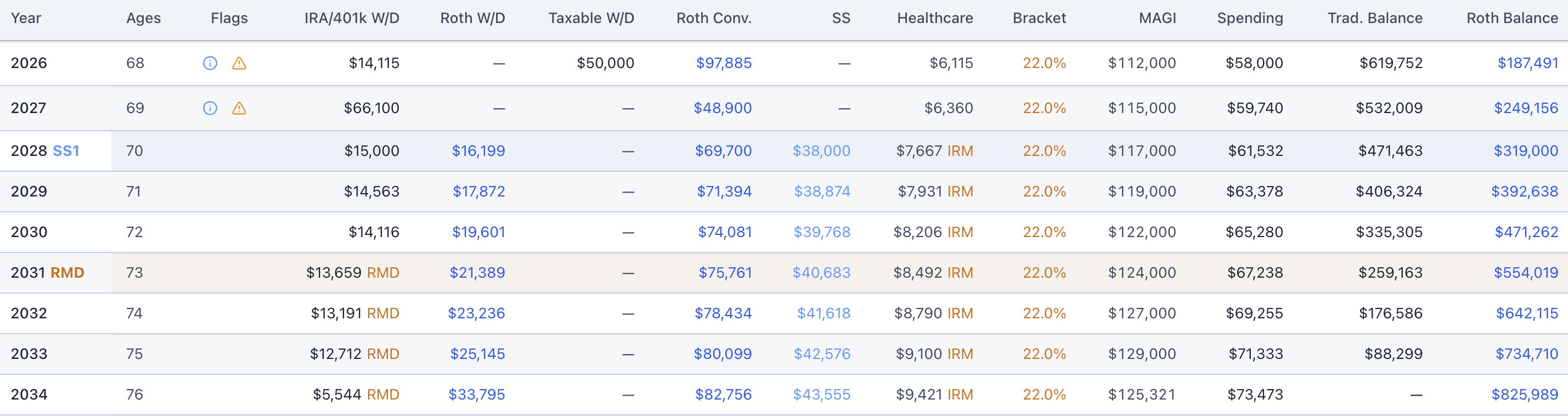
Social Security, RMDs, and Roth conversions need to be modeled together, not in isolation. ThunderHarbor's Tax Cliffs tab shows your income relative to every relevant threshold year by year, and the Projection Table shows the exact dollar impact of each scenario on your lifetime tax bill and portfolio balance.
Not financial advice
This guide is for informational purposes only. Nothing here constitutes financial, tax, or legal advice. Always consult a qualified professional before making significant financial decisions.
Model Social Security with your full retirement picture
ThunderHarbor compares every claiming age combination for both spouses alongside taxes, RMDs, Roth conversions, and portfolio longevity, all in one connected projection.
Build your free planFree plan included · Full Social Security optimizer with Premium ($47/year)