
June 13, 2026
Social Security Insolvency in 2032: What a 24% Cut Means for Your Plan
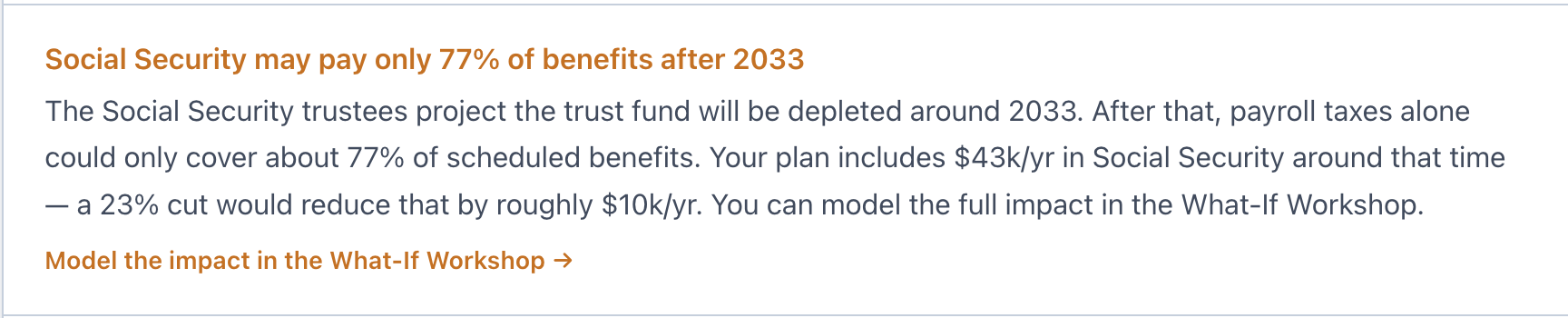
The 2026 Trustees Report moved Social Security’s projected insolvency date up to late 2032. That is a year earlier than last year’s estimate. If Congress does not act, the law requires an automatic cut to match incoming payroll tax revenue. That works out to about 76% of the scheduled benefit, close to $500 less a month for a typical retiree. This is not a fringe scenario. It is the current legal default. For most households it is a real cost that needs a real plan. But a smaller check is also a smaller number flowing into your tax return, and for people already managing Roth conversions, ACA subsidies, or IRMAA, that can open a door. Four case studies below show both sides.
What “insolvency” actually means
Social Security will not disappear in 2032. The program runs on payroll taxes from current workers, and those keep coming in no matter what. What runs out in 2032 is the reserve. That is the buffer built up over decades to cover the gap between what comes in and what goes out.
Once the reserve is gone, the program cannot borrow or run a deficit. Benefits get cut automatically, across the board, down to whatever payroll taxes can support. The Trustees and the Committee for a Responsible Federal Budget both put that level around 76% of scheduled benefits. For the average retiree, that is a cut of about $500 a month. The timeline moved up a year in this report. Part of that is a recent change in how benefits are taxed. Part of it is demographics: a lower birth rate and less immigration both mean fewer workers paying in relative to the number of people collecting.
Will Congress actually let this happen?
Probably not in full. Congress has stepped in before. An across the board cut to tens of millions of voters is exactly the kind of thing that tends to get fixed, at least partially, before it bites. But “probably not in full” is not a plan. Congress could act early and avoid the cut. It could act late and let it happen for a year or two before patching it. Or it could pass a partial fix that still leaves benefits a bit lower than scheduled. A plan that only works if none of that happens is fragile in exactly the way a good plan should not be.
The useful question is not “will this happen.” It is “if it happens, even for a few years, does my plan survive it without a crisis.” That is a question you can answer with math, and it is exactly what the Social Security tab in ThunderHarbor is built to test.
Case study 1: Maria, 60, planning to claim at 62
Maria’s full retirement age benefit is projected at $2,400 a month. She plans to claim early, at 62, in 2028. Claiming early permanently reduces her benefit to about 70% of that, or $1,680 a month. That is the number in her retirement budget.
In 2032, Maria turns 64. If the cut takes effect that year, her $1,680 drops to roughly 76% of that, about $1,277 a month. That is a $403 monthly cut, or just under $4,800 a year, on top of a benefit she already reduced once by claiming early. Over a 25-year retirement, if the cut is never reversed, that adds up to well over $100,000 she budgeted for and did not get.
For Maria, the fix is not to panic about claiming age. It is to make sure her portfolio can absorb roughly $400 a month starting in 2032, without a change in lifestyle. In the What-If Workshop, she can lower her Social Security input by 24% starting in 2032 and rerun her projection. If her plan still holds, the gap is already covered. If it does not, she has six years to close it.
Case study 2: David and Linda, already collecting since 2027
David and Linda retired in 2027. Together they collect $4,800 a month in Social Security, about half their retirement income. The rest comes from required minimum distributions on their traditional IRAs.
The cut applies to everyone receiving benefits in 2032, not just new claimants. Five years into retirement does not protect them. Their combined $4,800 drops to about $3,648. That is a loss of $1,152 a month, or roughly $13,800 a year. That gap has to come from their portfolio, which pushes their withdrawal rate up right when an unplanned increase does the most damage, if it lands in a year when markets are also down.
For David and Linda, the relevant question is not “can my portfolio survive a $13,800 a year hit.” It is “can it survive that hit in a year when the market is also down 15%.” That is a sequence of returns question. Running both cases side by side in Compare Scenarios shows whether the combination breaks the plan or just dents it.
Case study 3: Tom, 45, still twenty years out
Tom is 45 and plans to retire at 65, well after 2032. He has the most time to adjust, and also the most uncertainty. Nobody knows what Social Security will look like by the time he claims.
Tom’s advantage is that he does not need to predict the outcome. He can build his plan around 80% of his projected benefit instead of 100%, and check whether it still works. If it does, he has already absorbed a cut bigger than the one currently projected, whatever Congress decides. If it does not, he has two decades to close the gap. Higher savings, a later retirement age, or a different withdrawal mix are all still on the table at 45. None of them are at 65.
This is the cheapest version of the fix. The earlier you are from claiming, the less it costs to build in a margin. And the more likely it is that the margin turns out to be unnecessary.
Case study 4: Jenny, 64, converting to the top of the 12% bracket
So far, every case study here is about absorbing a loss. But a smaller Social Security check is also a smaller number feeding into your taxable income. For someone managing that number on purpose, a cut is not only a cost.
Jenny is 64 and retired. She collects $2,200 a month in Social Security, $26,400 a year, and most of it counts toward her taxable income. Each year she converts traditional IRA money to Roth, filling her bracket up to the top of the 12% rate and stopping there. She does not leave any room unused.
If the 2032 cut applies to her, Social Security drops to about $1,672 a month, $528 less. Most of that was counting toward her taxable income, so roughly $450 a month, about $5,400 a year, is now empty space in her 12% bracket. She can convert that much more from her IRA at the same 12% rate, for as long as the cut stays in effect.
That $5,400 moves out of a traditional IRA, where it would eventually come out as an RMD taxed at whatever bracket she is in later, and into a Roth, where it grows untouched and comes out tax free. The smaller check cost her $5,400. It also handed her $5,400 a year in fresh conversion room, at a rate she controls.
The same logic applies to ACA subsidies for anyone not yet on Medicare, and to IRMAA tiers for anyone who is. A smaller Social Security check means a smaller MAGI. For someone sitting just above a subsidy cliff or an IRMAA threshold, that swing can be the difference between losing a benefit worth far more than $500 a month, and keeping it.
What you can actually do about it
None of this means Social Security will not be there. It almost certainly will, in some form. But a plan that only works if it is fixed exactly on schedule, exactly as promised, is a bet you do not need to make. A few practical steps:
- Run your plan twice. Once with your full Social Security estimate, and once with it cut 20 to 24% starting in 2032. In the Social Security tab, this is a one-line change. The gap between the two outcomes is the actual size of the risk you are carrying.
- Delaying still helps, even with a cut. The cut is a percentage, so a bigger starting benefit from delaying to 67 or 70 is still bigger after the cut. Delaying does not protect you from the cut. But it does not stop working because of it either. Compare claiming ages with and without the cut applied to see how much of the delay credit survives.
- Build the buffer into your withdrawal plan, not your hopes. If a $400 to $1,000 a month gap would force a real lifestyle change, that is the number to solve for now. The On Track tab shows whether your current spending and withdrawals already have room for it.
- Check what a smaller check does to your MAGI, not just your income. If you are converting to Roth up to a bracket line, sitting near an ACA subsidy cliff, or close to an IRMAA tier, run the cut scenario in the Roth Strategy or Healthcare tabs before assuming it is pure loss. It might open a door instead.
Frequently asked questions
Will Social Security run out of money in 2032?
No. Social Security cannot disappear because it is funded by ongoing payroll taxes from current workers, and those keep coming in regardless of the trust fund balance. What happens in 2032 is that the trust fund reserve, the buffer built up over decades, is projected to run out. By law the program cannot borrow, so benefits would be automatically cut to match incoming payroll tax revenue, roughly 76% of scheduled amounts.
How big would a Social Security benefit cut be if Congress does nothing?
The 2026 Trustees Report and the Committee for a Responsible Federal Budget estimate an automatic cut in 2032 would reduce benefits to about 76% of the scheduled amount, a roughly 24% reduction. For a typical retiree, that is close to $500 less per month.
Does the cut apply to people already receiving benefits?
Yes. An automatic insolvency cut would apply across the board to everyone receiving benefits in 2032, not just new claimants. Being years into retirement already does not protect you from it.
Will delaying Social Security still help if benefits get cut?
Yes. The cut is a percentage applied to whatever benefit you are scheduled to receive. Delaying your claim from 67 to 70 still increases your base benefit by roughly 24% through delayed retirement credits, so a larger starting benefit stays larger after the cut.
Can a smaller Social Security check create planning opportunities?
For some retirees, yes. A smaller check also means a smaller contribution to MAGI. For someone doing Roth conversions up to a bracket line, or managing income to stay under an ACA subsidy cliff or IRMAA threshold, the reduced MAGI can open up room that partially offsets the loss.
Not financial advice
This article is for informational purposes only and reflects projections from the 2026 Social Security Trustees Report as reported by CBS News. Nothing here constitutes financial, tax, or legal advice. Always consult a qualified professional before making significant financial decisions.
See what a Social Security cut would do to your plan
ThunderHarbor projects your retirement year by year. Run your plan with your full benefit, then run it again with a reduced one, and see exactly where the gap shows up.
Start your free plan