
May 17, 2026
We Got the RMD Advice Partly Wrong: Here Is the Full Picture
For a while now, the standard retirement planning message, including ours, has been some version of this: your traditional 401k is going to generate large required minimum distributions at age 73 (or 75 if born in 1960 or later), those distributions will be taxed heavily, and you should convert to Roth as aggressively as you can to avoid the problem. That advice is right for some people. But we recently worked through the math more carefully, and for a significant group of savers it is actually wrong, and following it costs more in taxes than ignoring it. We want to walk through what we learned, because it changes what ThunderHarbor recommends and it should change how you think about your own plan.
Inflation works like compound interest, and it makes future numbers look scary for no reason
Say you are 43 years old today. Age 73 is 30 years away. When a retirement calculator tells you that your first required withdrawal at that age will be $240,000 per year, that number lands hard. It sounds enormous. And if you compare it against today's tax brackets, where $240,000 in income would push you well into the 24 percent bracket, the alarm feels justified. But you are comparing a number from 30 years in the future against a tax table from today, and that is exactly where the confusion starts.
But here is the thing most retirement tools do not explain clearly. That $240,000 is a nominal number. It is expressed in the dollars of whatever year you turn 73, not in today's dollars. Inflation does to purchasing power exactly what compounding does to a portfolio. It builds on itself year after year. Three percent annual inflation for 30 years does not give you a 90 percent increase. It gives you a 143 percent increase. One dollar today buys what $2.43 will buy in 30 years. So when a planner says your RMD will be $240,000 at age 73, in real purchasing power that is roughly equivalent to about $99,000 in today's dollars, which is a completely different conversation.
And tax brackets move the same way. Federal tax brackets have been indexed to inflation since 1985. The 12 percent bracket for a married couple tops out at roughly $97,000 of taxable income today. In 30 years, adjusted at the historical pace of 2.5 percent per year, that same bracket will top out at around $207,000 of taxable income. A $240,000 nominal RMD at age 73, after the inflation-adjusted standard deduction, can land squarely in the 12 percent bracket, not because the person became poorer, but because their income and the bracket limits both inflated in the same direction. The bracket in 2056 is not the same as the bracket in 2026, even if the percentage reads the same.
This does not mean RMDs are not worth planning for. It means the real question is a different one.
The question that actually matters: does your RMD exceed what you will spend?
The real problem with large RMDs is not the bracket. It is the gap between what the IRS forces you to withdraw and what you actually need to spend. The IRS calculates your required minimum distribution based on your account balance and a life expectancy table. It does not care what your mortgage is, what your grocery bill is, or how much you budgeted for travel. If your balance grew large, the withdrawal is large, whether you need the money or not.
If your RMD at 73 is $240,000 and your inflation-adjusted annual spending at that age is $380,000, there is no excess. You needed that income and more. The traditional 401k is doing exactly what it was supposed to do, providing taxable income in retirement that you actually consume. In that case, Roth conversions during your working years, when you are in a high bracket, make almost no sense. You are paying 32 percent now to avoid paying 22 percent later on money you were going to spend either way.
If your RMD at 73 is $240,000 and your inflation-adjusted spending is only $140,000, the picture is completely different. Now $100,000 per year is landing on your tax return as income you did not choose to take and did not need. That excess is the actual tax problem, and it is worth solving, specifically by converting enough of your traditional balance before 73 to bring the forced withdrawal closer to your spending level.
The key insight is that the same projected RMD can be a non-issue or a real problem depending entirely on how much you plan to spend. Your spending in retirement, adjusted for 30 years of inflation, is the benchmark everything else should be measured against.
Case study: Sarah, who should keep contributing to traditional and barely convert
Sarah is 45, earns $220,000, and is currently in the 24 percent federal bracket. She has $800,000 in her traditional 401k and contributes $23,000 per year. She plans to retire at 65 and expects to spend around $180,000 per year in today's dollars during retirement. She has a mortgage, she travels, her lifestyle is comfortable and she expects it to stay that way.
Her traditional balance at retirement, after 20 more years of contributions and 6 percent annual growth, is projected at roughly $4.2 million. After 8 more years of growth before RMDs begin, it sits at approximately $6.7 million. Her first required minimum distribution at 73 is roughly $253,000 in nominal 2056 dollars.
Now look at what her spending looks like in the same year. $180,000 per year today, inflating at 3 percent for 28 years until she turns 73, becomes approximately $412,000 in nominal 2056 dollars. Her projected RMD of $253,000 does not even cover her spending. She will need to pull additional money from her Roth or taxable accounts on top of it. There is no excess forced income at all. The RMD is genuinely needed and then some.
For Sarah, the right move is clear: continue contributing to her traditional 401k at 24 percent today, because her retirement spending will require those traditional withdrawals anyway. She will spend the money at whatever rate applies in retirement, which in her case looks like 22 to 24 percent on the amounts she needs, similar to what she is saving now. Converting large amounts during her working years would mean paying 24 percent today on dollars she would have withdrawn at a similar or lower rate later. That would be a bad trade.
ThunderHarbor now projects Sarah's inflation-adjusted spending at every age and compares it to her projected RMD. In her case the excess is zero, and the app reflects that. It shows her traditional contributions are working correctly and does not push aggressive Roth conversions at her. The old version of the app would have flagged her $6.7 million traditional balance as a problem. The new version tells her the truth: her spending will absorb it, keep going.
Case study: David, who really does need to convert
David is also 45, also earns $220,000, also has $800,000 in a traditional 401k and contributes $23,000 per year. He and his wife live modestly. They own their home outright, they do not take expensive vacations, and their retirement lifestyle target is roughly $70,000 per year in today's dollars. They genuinely do not need a lot of money to be happy.
His traditional balance follows the same trajectory as Sarah's: roughly $6.7 million at age 73, with a first RMD of $253,000 in nominal 2056 dollars.
But David's spending in 2056 is a very different number. $70,000 today inflating at 3 percent for 28 years becomes roughly $160,000 in nominal 2056 dollars. His RMD of $253,000 exceeds his spending need by $93,000 per year. That $93,000 is the actual problem. It is income the IRS forces him to take, it goes on his tax return, and it likely triggers IRMAA Medicare surcharges on top of his regular tax bill. He does not need it and cannot avoid it.
The right strategy for David is targeted: he wants to reduce his traditional balance enough that the eventual RMD at 73 lands close to $160,000 rather than $253,000. That means a traditional balance at 73 of roughly $4.2 million rather than $6.7 million, a reduction of about $2.5 million. With 8 years between retirement at 65 and RMDs at 73, David can convert roughly $310,000 per year during that gap, when his income is low, at a much lower effective rate than the 24 percent he pays while working. The math works clearly in his favor.
Notice the crucial difference between Sarah and David. Same income. Same account balance. Same contribution rate. Same growth rate. Same projected RMD. Opposite conclusions about whether to convert. The only thing that differs is how much they plan to spend. That is why the question your planner should be asking is not just "how large is your traditional balance?" but "will your RMD exceed what you will actually need to spend?"
What this means for traditional 401k contributions right now
If you are a high earner in the 24, 32, or 37 percent bracket, the traditional 401k is still a good deal for most of you, probably a better deal than the popular retirement advice suggests. Every dollar you contribute today avoids tax at your current high rate. When you withdraw in retirement, you pay tax at whatever rate applies to the income you actually need to spend. If that spending absorbs your full RMD, you have deferred taxes at 32 percent and will pay them at 22 or 24 percent. That is straightforward savings.
The argument for traditional becomes even stronger when you account for the fact that you are investing the tax savings during your working years. The money that would have gone to the IRS stays in your account, compounds for decades, and increases the after-tax wealth you end up with.
The argument for Roth conversions applies specifically and precisely to the excess: the gap between your projected RMD and your projected spending. If you have excess, you should convert enough to eliminate it. If you do not have excess, conversions are at best optional and at worst a way to pay taxes early on money that would have been better left to compound.
How ThunderHarbor now models this
We updated the projection engine to compute your inflation-adjusted spending at every future age and compare it directly against your projected RMD. The spending you enter today in today's dollars gets inflated forward at your assumed inflation rate year by year, so when we reach age 73 in the model, we compare your nominal RMD against your nominal spending, both expressed in the same future dollars, an apples-to-apples comparison.
If the excess is small or zero, the app now tells you explicitly: your RMDs fall within your spending needs, and traditional contributions continue to make sense. It will not push you toward Roth conversions that do not actually help your situation.
If the excess is meaningful, the app shows you the actual excess amount, not the raw RMD but the portion above your spending that represents genuine unnecessary taxable income. It then shows you how much converting during your retirement gap years would cost versus how much it saves, and lets you decide. The Roth conversion recommendation is now calibrated to the excess, not to the size of your balance in isolation.
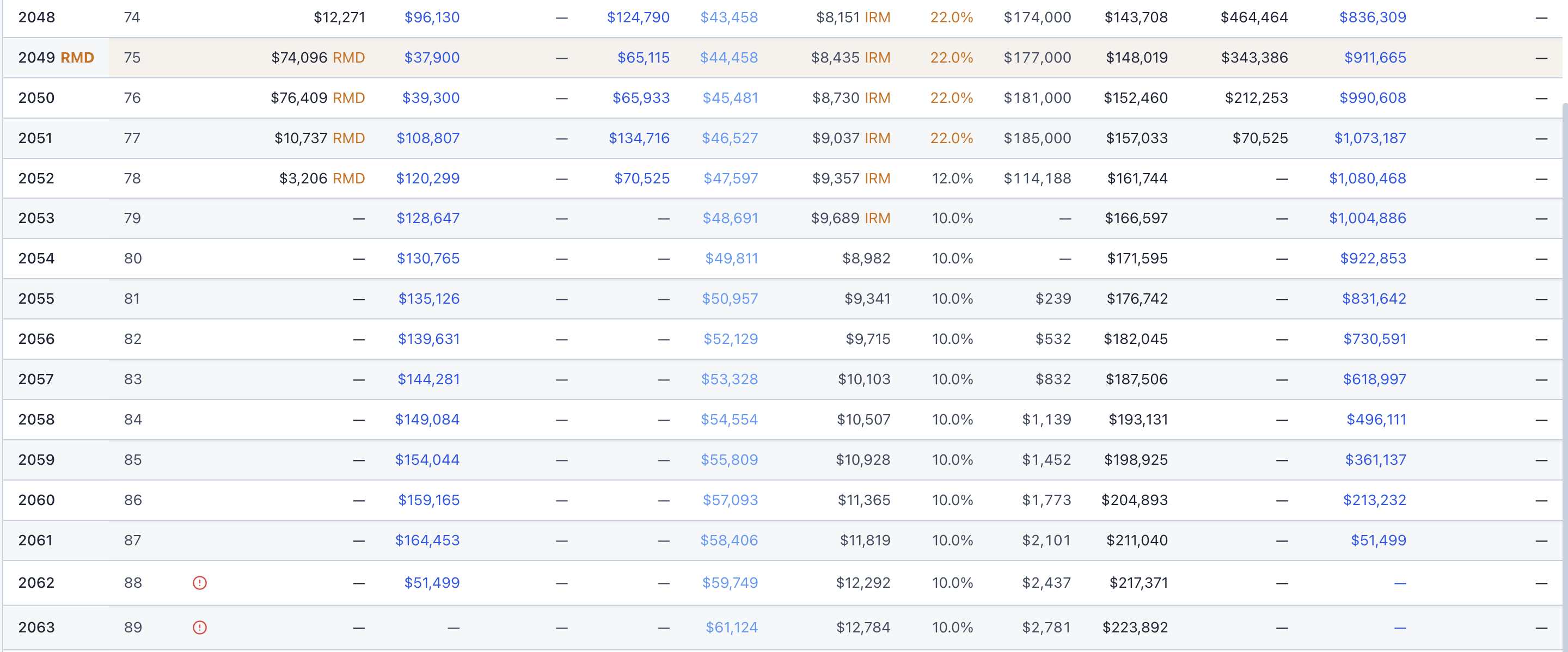
We have also added clearer context throughout the app that all projected dollar amounts are in future nominal values. A projected $250,000 RMD in 2056 is not $250,000 in today's purchasing power. Both the income and the bracket thresholds will have grown with inflation. The meaningful comparison is always the excess above spending, and always within the same year's dollars.
The one thing that does not change
None of this changes the value of the gap-year conversion window. If you retire at 65 and RMDs start at 73, those 8 years are typically your lowest-income period: no salary, Social Security not yet started, portfolio withdrawals modest. For people who do have excess RMDs, converting during those years is exactly the right move. The rate you pay on conversions in those years will almost always be lower than the rate you would pay if the same dollars came out as forced RMDs later, on top of Social Security and whatever else you have.
The change is in the target. You are not trying to drain your traditional account as fast as possible. You are trying to bring your projected RMD at 73 in line with your projected spending at 73, not below it, not far above it, just roughly matching so that forced income does not significantly exceed what you actually need. That is a much more specific and achievable goal than "convert as much as you can."
Your spending is the benchmark. Enter it thoughtfully, because the app will inflate it forward and use it to determine whether your RMD situation is genuinely a problem, or genuinely fine.
Not financial advice
This article is for informational purposes only. Case study numbers are illustrative and use simplified assumptions. Your actual projected RMD, spending, and tax situation depend on many factors including market returns, tax law changes, and personal circumstances. Always consult a qualified financial professional before making significant decisions.
See whether your RMD actually exceeds your spending
ThunderHarbor projects your inflation-adjusted spending forward to the year you turn 73 and compares it directly against your projected RMD, so you know whether conversion is a genuine priority or not.
Run your projection